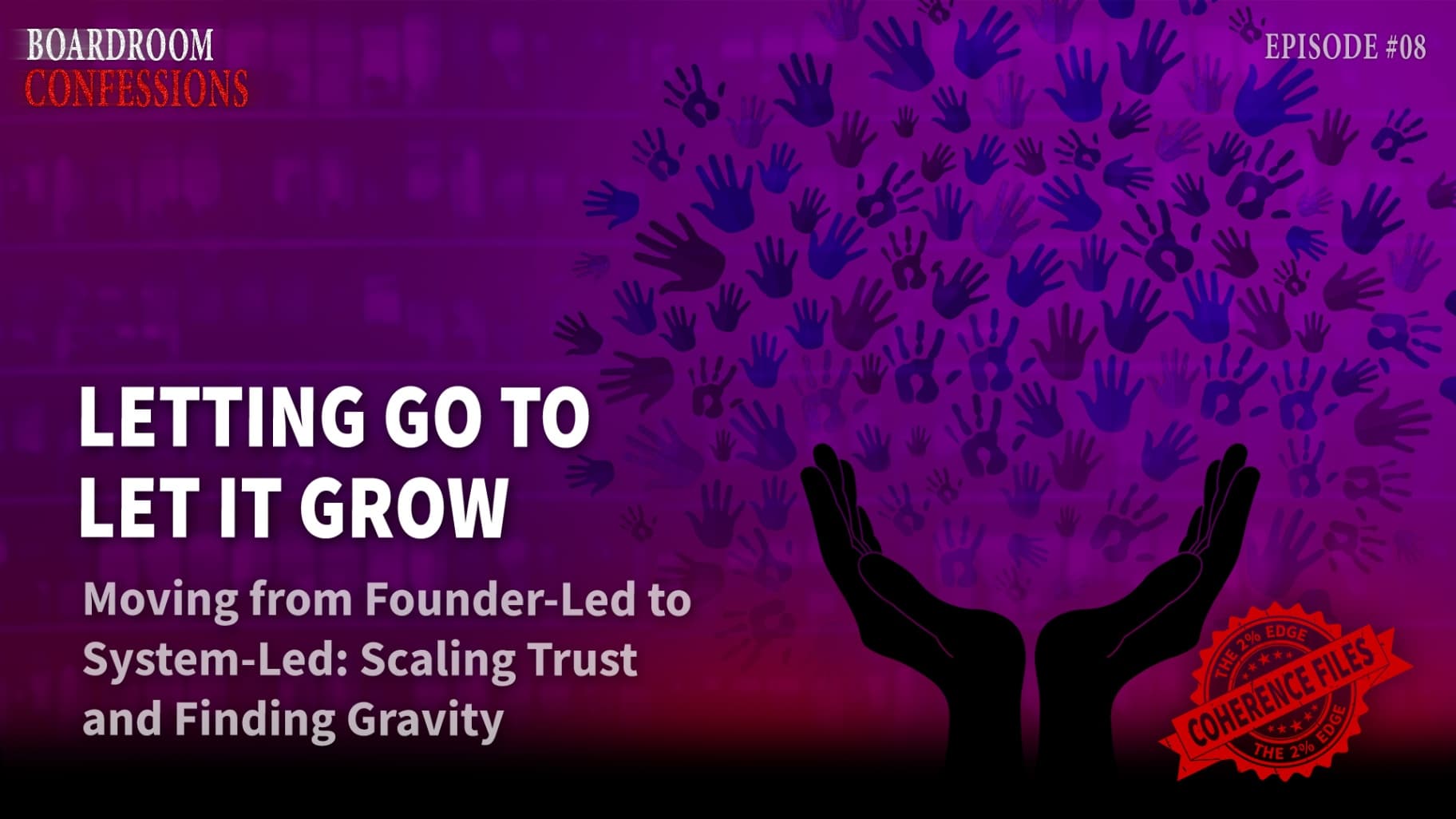
Moving from Founder-Led to System-Led: Scaling Trust and Finding Gravity
We left the last episode of Boardroom Confessions at an intense moment.
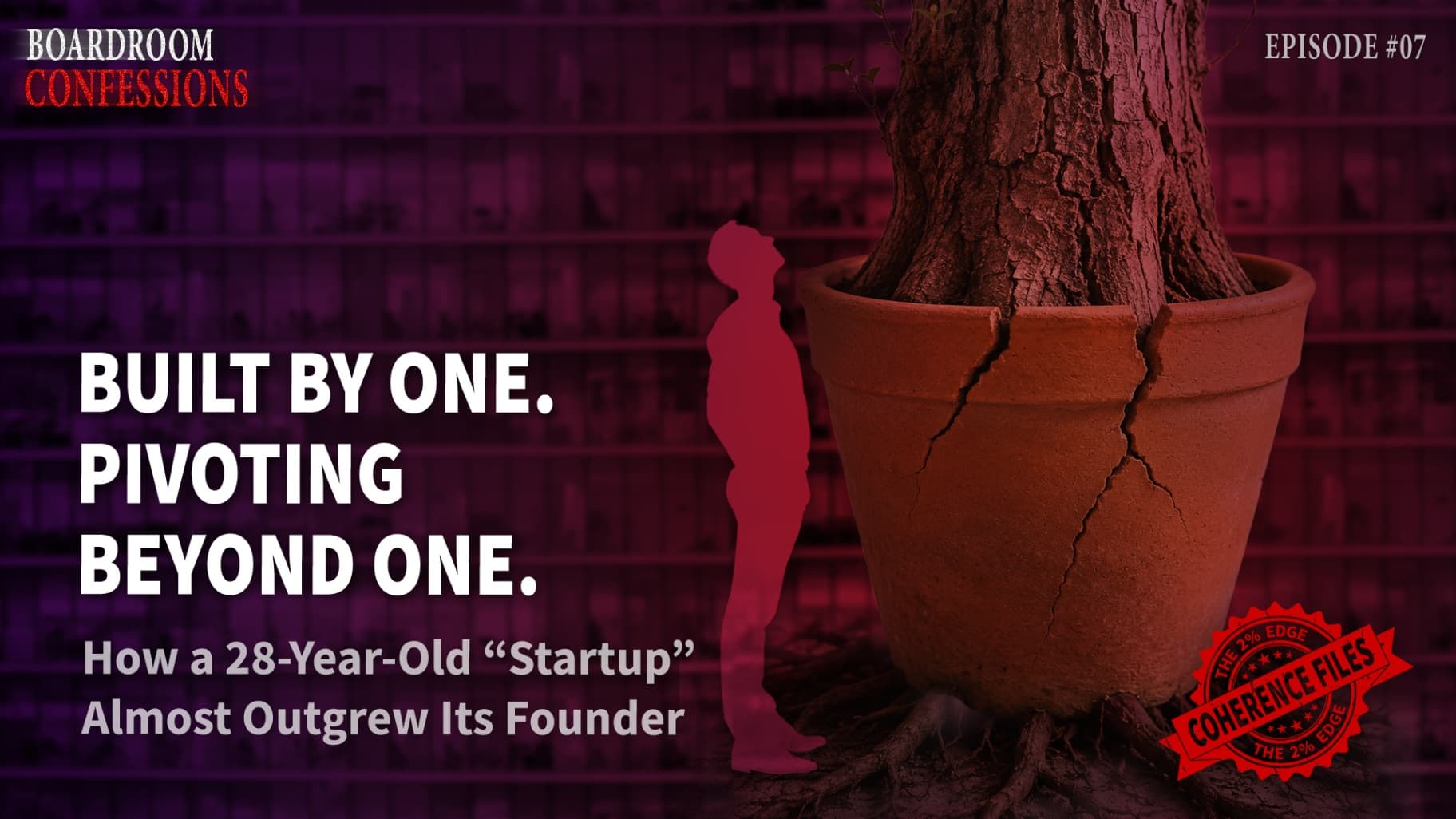
The founder had recognized that the business could no longer grow the way it had for 28 years. It could no longer hold to its founder as the center of gravity. It needed to pivot — not because the previous approach had failed, but because the company had outgrown it.
Recognizing this was one of the most difficult moments for Aakash, but the much needed first step to let the organization reach for its expanded horizons.
What follows is far more personal.
Every change asks people to leave behind something they have invested in. Their ideas, projects, ways of working, even parts of their identity.
How do you step back from something that has been an extension of yourself for decades?
How do you ask a team to pivot again without making them feel that their past work no longer mattered?
How do you keep trust intact while the ground beneath everyone is shifting?
This month's Boardroom Confession begins here.
From Fragmented Identity to Coherence
At the heart of the Coherence Code™ is a simple, proven idea:
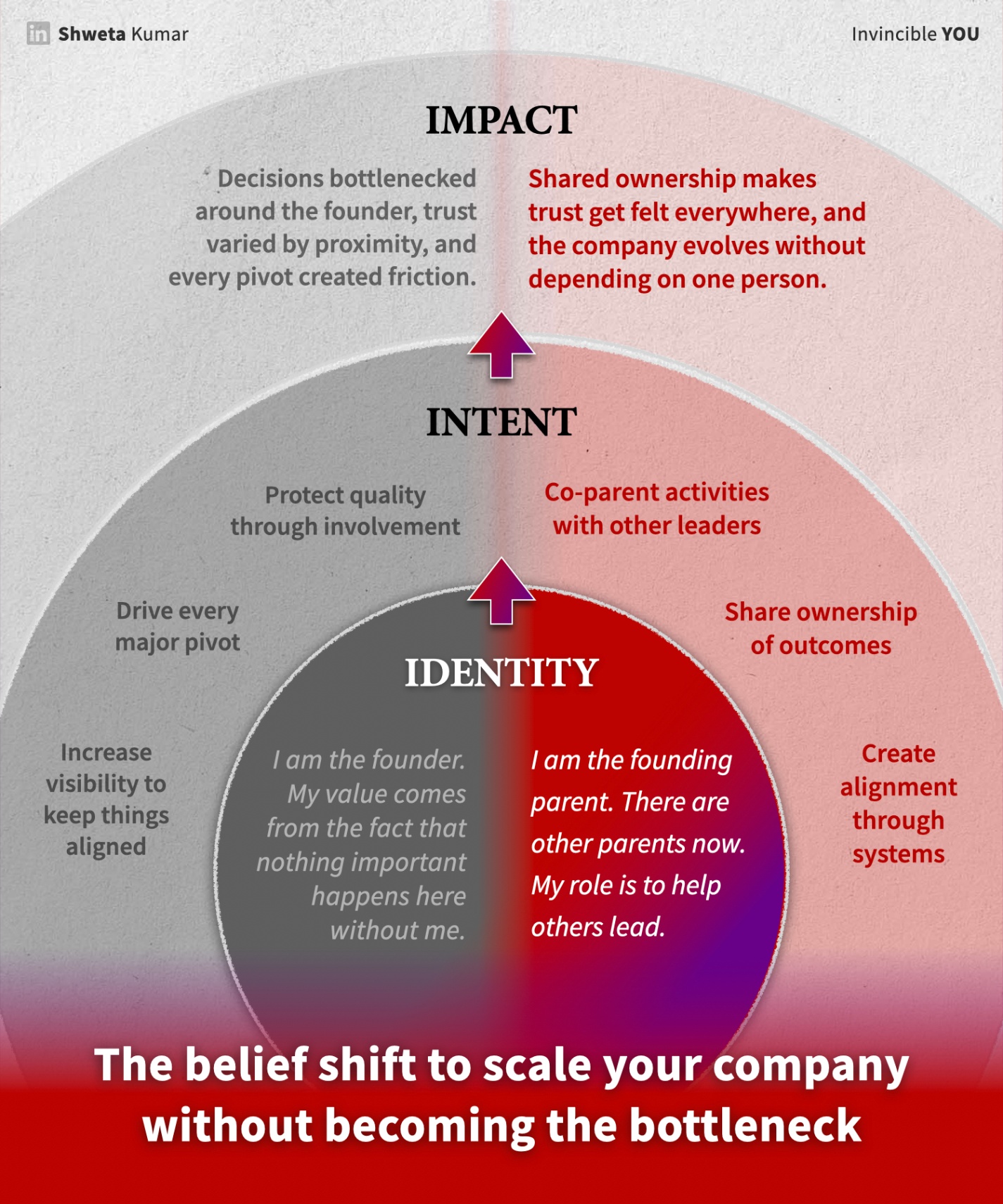
Sustainable leadership effectiveness works when only three things line up.
-
Identity: Who the leader believes they are.
-
Intent: The choices they make from that identity.
-
Impact: What the organisation actually experiences.
When those three are aligned, organisations move with surprising clarity.
When they aren't, even good systems struggle. Every decision, process, and intervention gets filtered through an incoherent engine.
In Aakash's case, the misalignment was particularly acute because of the multi-locational stretch:
-
Identity
"I am the founder. The company is mine to see, mine to feel, mine to pivot. My value comes from the fact that nothing important happens here without me." -
Intent
Build a scaled, multi-location fintech that could outlive him. -
Impact
A company where decisions bottlenecked around one person.
A company where trust varied depending on tenure and proximity to the founder.
A company that could pivot brilliantly in theory, but struggled through the human consequences of those pivots.
And a founder who was burning out alongside his team.
The identity that had built the company was now getting in the way of the company it had built. This is one of the most common transition wounds for founders who have spent decades growing an organisation.
It is rarely solved by hiring more executives. It is resolved when the founder learns to anchor their identity in something larger than being needed everywhere.
By the end of the engagement, that shift had begun.
-
Identity
"I am the founding parent of this company. There are other parents now. My job is to create the conditions for leadership, not to be present in every room." -
Intent
Build a company that can pivot with its leadership, not underneath it. -
Impact
Trust scores improved across locations and tenure groups.
Execution indicators improved alongside them.
The trust gap between old and new employees across locations narrowed significantly, although it had not disappeared entirely. Aakash will need to keep working on this. And he knows it.
Why We Didn't Start With Laying Out Good-Practices
One of the most common mistakes in transformation work is assuming that every problem should be solved where it is most visible.
Aakash's most obvious problem was decision-making.
Everything flowed through him. The executive team was frustrated. People were waiting for approvals that should never have needed founder involvement.
So it would have been tempting to start with governance. Create decision rights, redraw authority, push decisions down.
But the diagnostic told a different story.
The deeper issue wasn't structure.
It was trust.
The Coherence BRIDGE™ methodology reveals a principle:
When several trust circuits are broken at the same time, the order of repair matters.
Get the sequence wrong and you create compliance without belief.
Get it right and improvements begin to reinforce each other.
Three sequencing principles shaped the work:
Principle one:
Repair affective trust before structural trust.
Reciprocity and Benevolence sit at the emotional core of the BRIDGE model. They also move fastest when leaders visibly change their behaviour.
If you introduce governance structures before repairing those circuits, people may comply with the new system but they won't believe in it. So we began with interventions that addressed Reciprocity and Benevolence before introducing structural protocols.
Principle two:
Name what isn't changing before talking about what is.
In a company that has pivoted seven times, every new intervention is read as the eighth pivot until proven otherwise. People do not engage with new structures if they believe those structures will be retired in the next pivot. The Held/Moving Map was therefore the first structural protocol, because it declared what was not changing — including, critically, the intervention architecture itself.
Principle three:
Move from individual to system.
The earliest interventions necessarily depended on Aakash’s personal commitment. The work was not complete until those interventions were institutionalised — embedded in governance rhythms, board calendars, written policies, and role definitions that would survive Aakash’s personal vigilance. A protocol that depends on the founder remembering it is not a protocol. It is a habit. Habits regress under pressure. Institutions do not.
Mapping these principles onto the diagnostic produced the following intervention sequence:
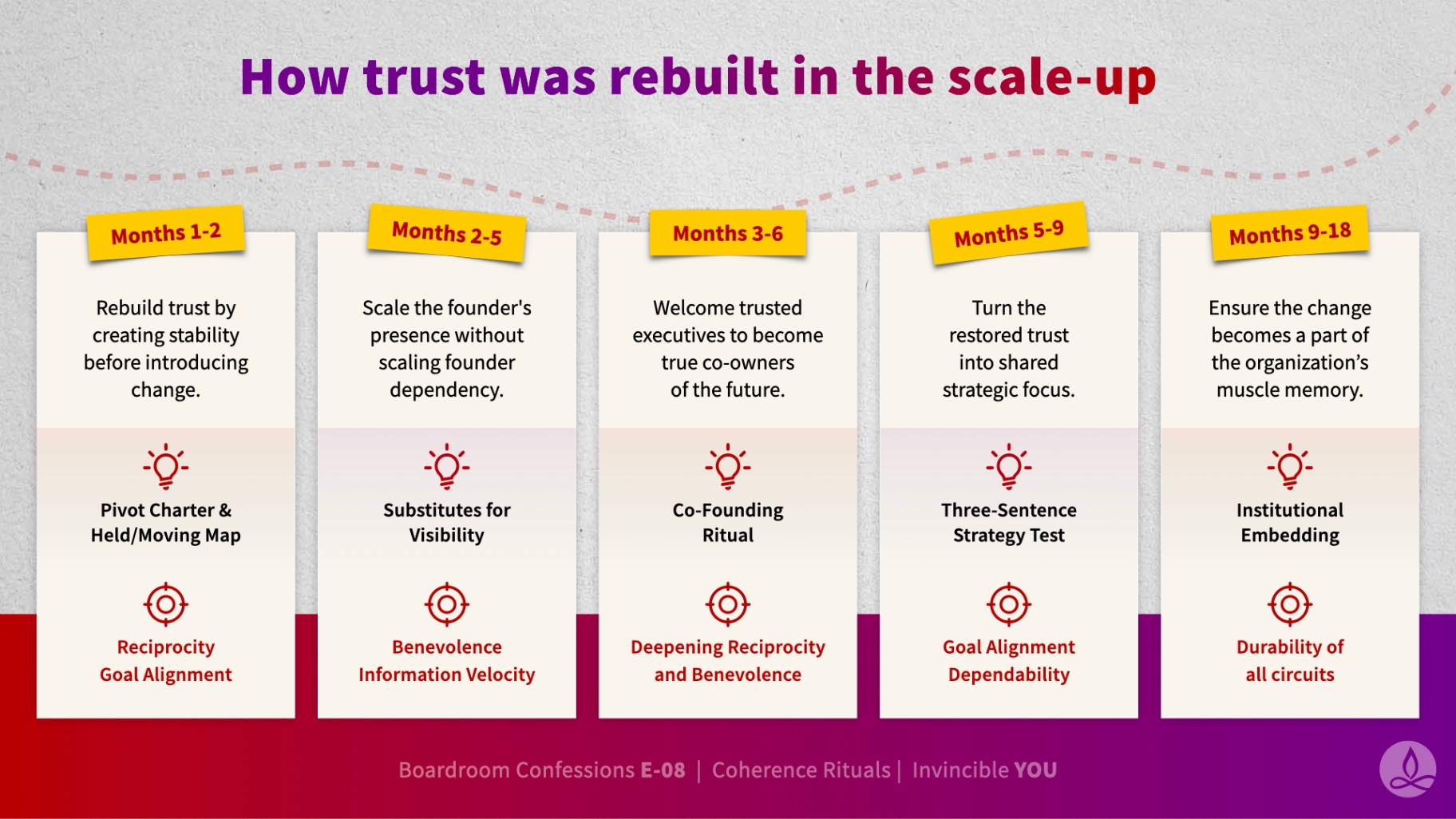
This architecture answers the question why we did not begin with the Decision Rights Register, which would have been a tempting first move given Aakash’s decision bottleneck and the executive team’s evident frustration.
Diagnostically, the Reciprocity score (1.8) was lower than the Goal Alignment score (2.1) and substantially lower than the Dependability score (2.5). Imposing a Decision Rights Register before Reciprocity was repaired would have produced a document the team did not believe in, signed off by a founder who would override it the next time he felt anxious. The register became powerful in month four — after Reciprocity had moved from 1.8 to 2.4 — precisely because it was now codifying a shift that had already begun, rather than mandating one that had not.
The same logic applied to the Co-Founding Ritual. It is, on paper, the kind of intervention that could be delivered in week one. Diagnostically, it could not. A founder who has not yet experienced what it feels like to step back from one decision will not survive ceremonially handing over parenthood of seven domains. The ritual was sequenced in months three to six because it required the leader to have already practised the small relinquishments before he could hold the large one.
Building the Coherence Bridge: The Interventions
With the sequence of interventions in place, the engagement unfolded in three phases. Each intervention is described below in two registers:
-
The personal register (what the founder did and felt)
-
The system register (how the protocol was institutionalised so it would survive Aakash’s personal commitment).
The second register matters as much as the first. An intervention that lives only in the founder’s discipline is one bad week away from extinction. An intervention embedded in governance survives the founder.
The diagnostic phase combined the BRIDGE trust circuit assessment, the DriftX execution indicator measurement, and fifty-four anonymous pulse interviews across all four primary locations. It concluded with a recognition session in which Aakash was presented with the diagnostic, the asymmetric trust map, and the bimodal benevolence distribution.
He read it for forty minutes without speaking.
When he finally looked up, he said: “I have been managing this company as if it still has two desks and a fax machine. I have eleven hundred people. And I am running it like I’m still the only one in the room.”
That sentence became the unlocking phrase for the work.
Months 1–2: The Pivot Charter — When To Move and When To Hold
One pattern became clear very quickly: not every pivot was strategic. Sometimes the company was responding to a genuine market shift. Other times, it was responding to the founder's anxiety.
So we created a simple filter to distinguish between the two.
The impact was immediate. Decisions became more deliberate. The organisation stopped reacting to every new idea and started evaluating whether a change was truly necessary. What had once felt like constant motion began to feel like intentional progress.
The first test of this Pivot Charter came in month three, when Aakash returned from a fintech conference in Singapore convinced the company needed to pivot — for the eighth time — towards a B2B-licensed-software model in addition to its retail business. The executive team, applying the charter, classified it as Anxious. Aakash held. Six months later, with more market data and competitive intelligence, the same proposal was classified Strategic and was actioned — but as a deliberate, well-sequenced, board-approved move rather than a founder’s enthusiasm.
As Aakash later reflected:
“I learned something I should have learned twenty years ago,” he said, “Most pivots are not necessary. The discipline is not in pivoting. It is in not pivoting on the days when pivoting feels like the only thing that will calm me down.”
Months 1–3: The Held/Moving Map — Anchoring People Through Change
After seven pivots, employees no longer knew what they could rely on. Every change felt like it might rewrite the company all over again.
We introduced a practice:
Every major change would clearly communicate what was changing and what would remain constant.
The effect was profound. People stopped experiencing every new initiative as another disruption. They finally had something solid to stand on, even while the company continued evolving.
The organisation no longer felt like it was constantly reinventing itself. It felt like it was growing.
Months 2–5: The Visibility Substitutes — Replacing Presence with Rhythm
Aakash had built the company by being physically present. As the company expanded across locations, that became impossible. Yet trust still seemed tied to proximity.
The work here wasn't about making him more available. It was about creating consistent rhythms that allowed connection, visibility and decision-making to happen without him being in every room. We introduced 4 specific rituals to make this possible. (If you’d like more details on this, feel free to send me a message.)
Over time, decisions moved faster, leaders became more confident, and trust stopped depending on whether the founder was physically present. The company learned something important:
Presence builds trust. But trust can also travel through systems.
Months 3–6: The Co-Founding Ritual — Welcoming Other Parents
This was the most emotional part of the journey.
For years, Aakash had been carrying the company like its only parent. The business had grown, but his identity had not. So we designed a powerful intervention that will let him publicly acknowledge the leaders who were already carrying critical parts of the company and formally share responsibility with them. We gave him the process of going through this announcement along with structures and rituals he will need in place, once the announcement is through.
The ritual was, on paper, a small organisational ceremony. In practice, it was the moment Aakash began grieving the version of his company in which he was the only parent. He cried during the announcement. So did three of the seven leaders he recognized.
The Bengaluru engineering head, who had been with the company for four years and had felt, for most of those years, like a hired hand, told me later: “For the first time, I understood that he was not just letting me lead a function. He was letting me share something he had built with his life. That changes how you carry the work.”
This Co-Founding Ritual contributed, alongside the broader trust circuit repair work, to the largest single shift in the engagement: the bimodal distribution of benevolence scores narrowed from a 1.5-point gap (1.7 to 3.2) at baseline to a 0.4-point gap (3.3 to 3.7) at endpoint. The company had, finally, become one company.
What changed wasn't structure.
It was ownership.
Months 5–9: The Three-Sentence Strategy — From Seven Mountains to One
Years of pivots had left behind layers of priorities.
Different teams were chasing different versions of success.
The solution wasn't adding more clarity. It was removing competing priorities.
Aakash was asked to make a series of difficult decisions about what the company would no longer pursue. The result was remarkable. Strategic confusion dropped dramatically. Teams stopped spreading their energy across seven mountains.
Within four months, the number of distinct answers to “what are this company’s three priorities?” dropped from twenty-nine to four. Not three (because healthy organisations have productive disagreement). Four, where the disagreements were known and negotiated rather than invisible and compounding.
Months 9–18: Stabilisation and System Embedding
The final phase wasn't about introducing anything new. It was about making sure the changes survived beyond Aakash's personal discipline, because that's the real test of transformation. Not whether a founder can behave differently for a few months, but whether the organisation can continue operating differently on a bad day.
Over the next several months, the new ways of working were embedded into governance, leadership rhythms, succession plans, and board oversight. What had started as personal commitments slowly became organisational habits.
The real proof came under pressure.
When a regulatory issue surfaced, Aakash did what he would never have done eighteen months earlier. Instead of taking over, he trusted his team to lead the response. He participated, but he did not become the response.
A few months later, a senior leader unexpectedly resigned. In the past, this would have triggered weeks of founder-led firefighting. This time, the leadership team already had the information, clarity and succession plans needed to respond quickly. The business absorbed the shock and kept moving.
That was the clearest sign of progress.
The company was no longer functioning because Aakash was holding everything together. It was functioning because the system was. And perhaps that is the real definition of a scalable organisation: Not one where the founder becomes irrelevant. But one where the founder is no longer indispensable.
Year One and Beyond: The Transformation in Numbers and in People
Nineteen months after our first conversation, the data told a story of genuine organisational repair.
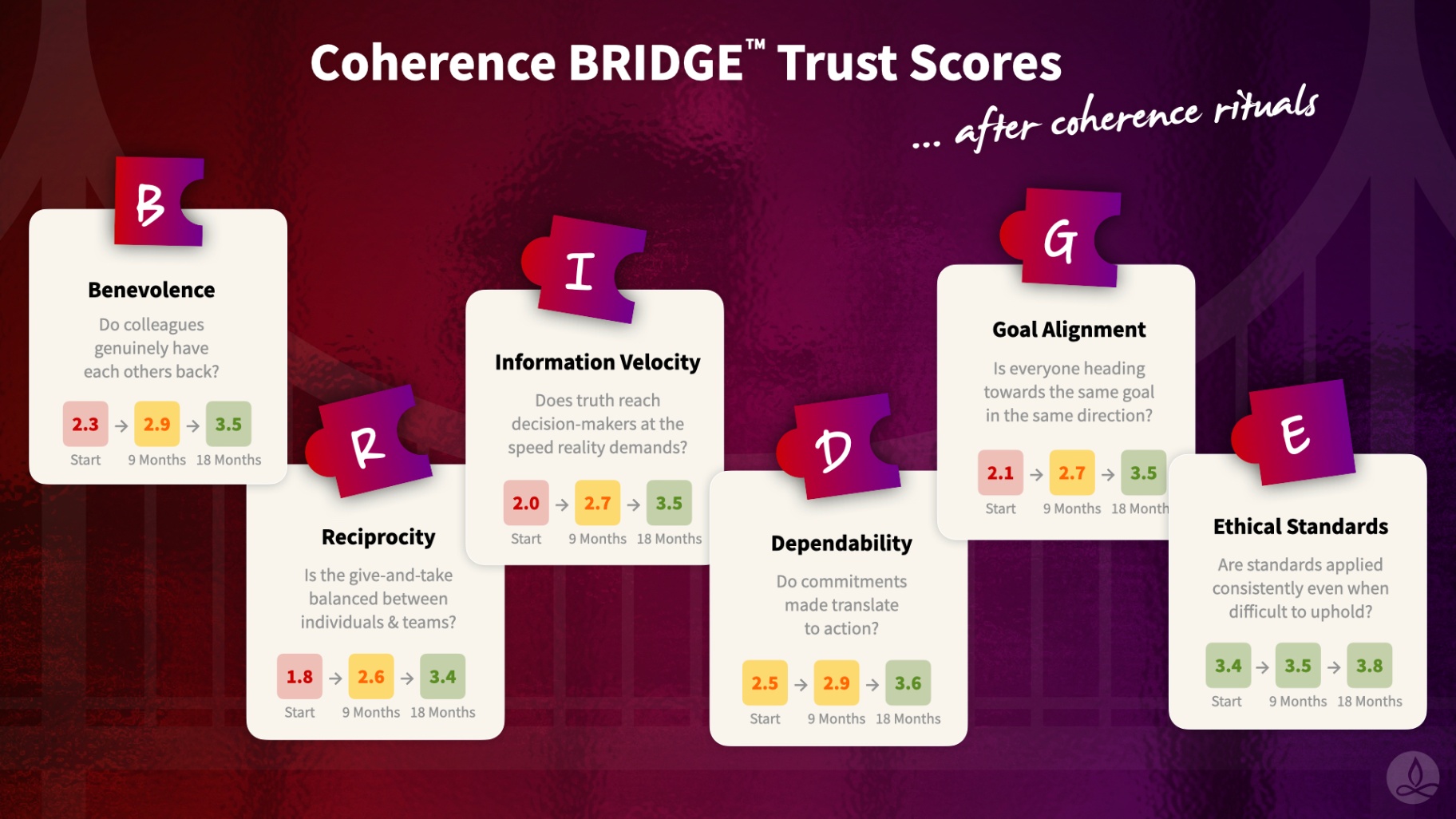
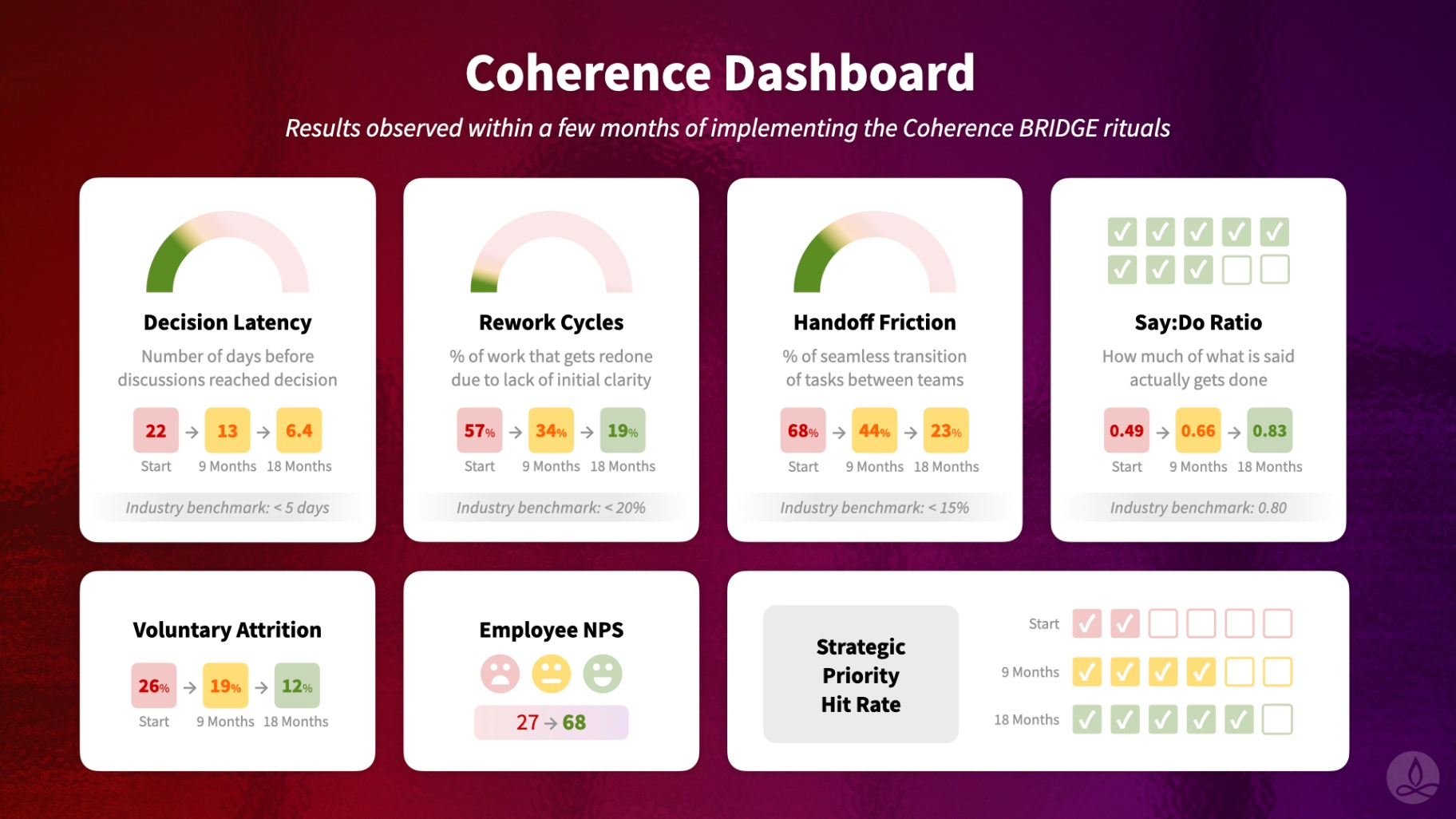
But the numbers, as always, were the shadow of the human reality.
The Hyderabad operations head, who had arrived fourteen months before the engagement and had privately been planning to leave by mid-2024, chose to stay. Her reason, shared with me privately:
“I came to a Series D fintech and ended up reporting into a Series A founder’s anxiety. By the end of the year, I was reporting into a founder. That’s the difference. He became the leader I had thought I was joining.”
The Bengaluru engineering head, who had been one of the seven named in the Co-Founding Ritual, told me at our final review:
“Before the ritual, I was an executive. After it, I was a partner. I cannot describe how much harder I work for the same man, now that I work with him instead of for him.”
And the thirty-one-year-old engineering manager whose pulse interview quote had unlocked the engagement — the office is where the trust is consumed — was promoted in month fifteen to lead a critical platform team. He met Aakash for the first time in person in month seventeen, in the Bengaluru office, during one of the Founder’s Forum visits. They spent forty minutes together. Aakash sent me a message that evening from the Bengaluru airport.
“I just spent an hour with someone I should have known for two years. The trust was already there before we met. I had not understood, until tonight, that this was possible. I had been telling myself I needed to see them to trust them. The truth is they had built the trust without me. I just needed to show up to receive it.”
The Founder Who Learned to Be One Among Several
The most striking moment of the engagement happened two months after the endpoint measurement. The company was preparing for its annual leadership offsite — the same offsite at which, twelve months earlier, Aakash had presented the AI-advisory pivot in a sixty-slide deck that he had written entirely himself.
This year, he sent me the agenda the night before the offsite.
The opening session was being delivered by the seven Co-Founding leaders. Together. Each presenting one slice of the year’s strategic narrative. Aakash’s name was on the agenda, but only in slot four — the second day, after lunch. His session was titled, in his own words: “What the Founder Learned This Year.”
He sent me one message: “I will speak for twenty minutes. I will not present strategy. I will tell them what they have taught me. Is that the right thing to do?”
I sent back a single sentence: “It is the only thing left worth doing.”
He spoke for nineteen minutes. According to several leaders who shared the session with me afterwards, he cried twice. He named, by name, the seven Co-Founding leaders and what each of them had built that he could not have built. He named, by name, four leaders who had left the company in the past two years and acknowledged, publicly, that some of them had left because of him. He named, by name, the engineering manager from Bengaluru and the operations head from Hyderabad and described what they had taught him about trust at distance.
He closed with one sentence that I have, with his permission, kept.
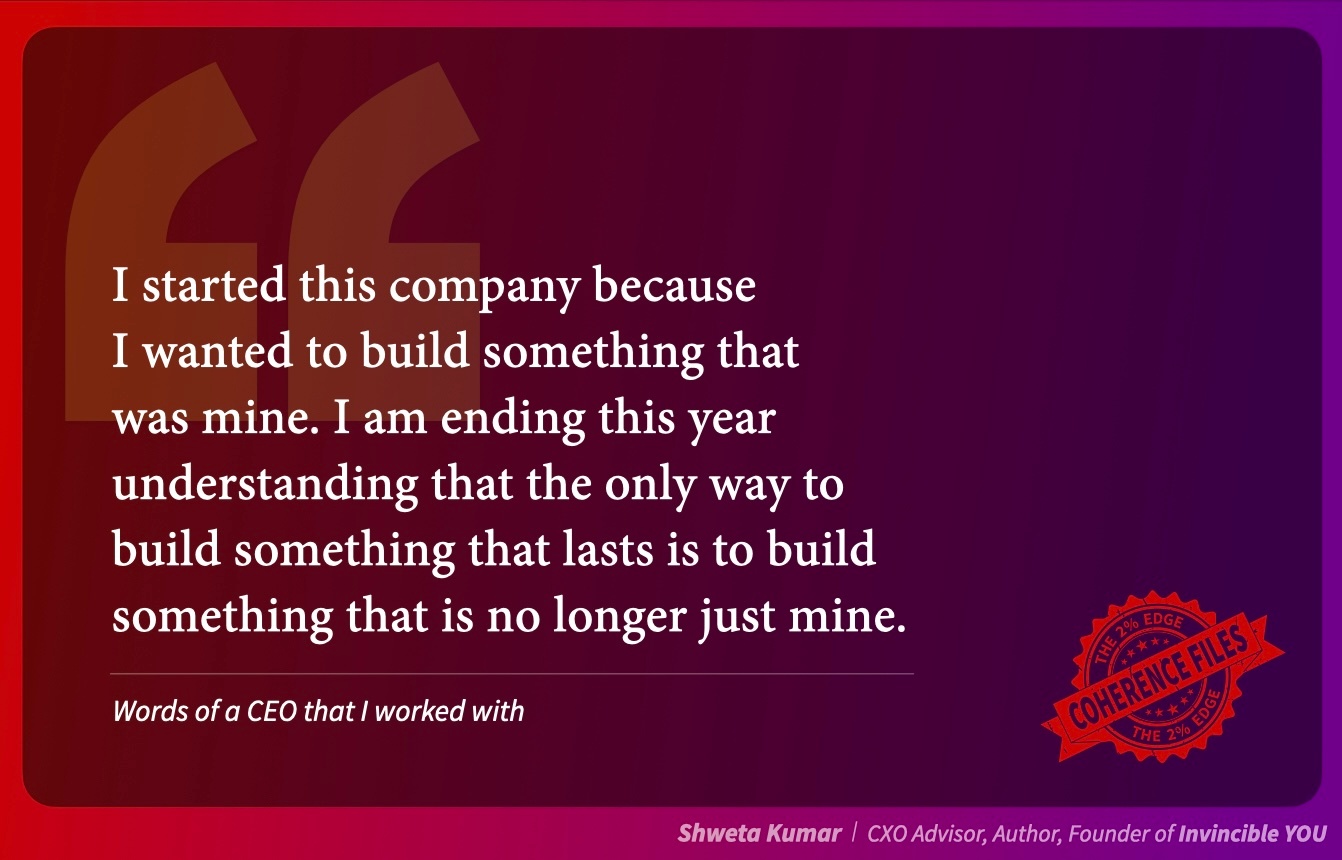
What Aakash Taught Me
Trust breaks differently at different stages of growth.
Aakash hadn't failed to build trust. In fact, six successful pivots were proof that he had built a great deal of it. The problem was that the trust model that worked in one office, with people he saw every day, didn't automatically work across four locations and 1,100 employees. What broke wasn't trust itself. It was trust at a distance.
Leadership has to travel farther than the leader can.
One insight this case reinforced for me is that leaders often assume their intent reaches everyone equally. It doesn't. The people sitting closest to you experience a very different version of your leadership than the people hundreds of miles away. If your communication, visibility and trust-building behaviours don't reach distant teams, the organisation slowly splits into different realities.
Presence is a gift. It cannot be the operating system.
Many founders trust what they can see. A conversation in the corridor, a lunch meeting, a quick check-in. But once a company scales, those moments become too rare to carry the culture. The answer isn't forcing more presence. It's building systems, rituals and rhythms that make trust possible even when people aren't in the same room.
Sometimes the addiction isn't growth. It's pivoting.
Aakash helped me see how easy it is for successful founders to fall in love with change itself. Every new pivot brings energy, possibility and a return to the centre of the action. But constant movement can become a substitute for the harder work of staying the course and trusting others to lead. Often, the real discipline is not knowing when to pivot. It's knowing when not to.
The hardest thing to delegate is not authority. It's parenthood.
Most founders can eventually hand over decisions, budgets and responsibilities. What is far harder is accepting that the company now belongs emotionally to other people too. The breakthrough came when Aakash stopped seeing himself as the only parent of the organisation and began making room for others to carry that responsibility alongside him.
Good ideas don't create lasting change. Systems do.
Many transformations fail because they rely on the founder's commitment alone. Commitment fades under pressure. Systems endure. The real shift happened when new behaviours were embedded into governance, leadership rhythms and decision-making processes. Once the company no longer depended on Aakash remembering, the change became durable.
Leaders create drift, but systems often reward it.
This story isn't only about one founder. For years, the market rewarded speed, visibility and constant reinvention. Investors applauded pivots. Employees expected the founder to have the answers. Many of the behaviours that later became bottlenecks were once the very behaviours that made the company successful. Sustainable change required addressing both the leader and the environment that had quietly reinforced those patterns.
In the end, Aakash's journey wasn't really about delegation, governance or scaling. It was about identity.
The founder who began by believing the company could only thrive through him…. eventually discovered that the strongest thing he could build was a company capable of thriving beyond him.
The Last Image
Last month, Aakash referred a younger founder to me — a thirty-six-year-old building a healthcare platform that had just closed its Series B and was opening its second city office.
When I asked Aakash what he had told this founder about our work together, he said:
“I told him that Shweta would not give him new ways to control the company. She would, instead, give him new ways to let go of it. And that letting go is not loss. It is the only thing that allows the company to grow into what it is meant to become. I told him I had been a founder for twenty-eight years before I understood that there is a moment in every founder’s life when the most loving thing you can do for the thing you have built is to no longer hold it alone.”
I asked Aakash if he was fully there himself.
He laughed — that easy, unguarded laugh I had not heard in our first conversation, the laugh of a man who had stopped having to perform for his own company.
“Not fully,” he said. “I still want to know what’s happening on every floor of every office every day. I still check my phone too often. I still feel a small panic when I am asked to step out of a decision. But Shweta — the panic passes now. It used to be the room I lived in. Now it’s just a room I visit.”
He paused, looking out his Mumbai window towards the sea. The same window, the same sea, the same city. A different man.
“I built this company because I needed to be needed. I am keeping this company by learning to be needed less. There is a peace in that I did not know was available. And I think — I really think — the company will outlive me now. Which is the only thing, in the end, that any of us are doing this for.”
If parts of Aakash's story felt uncomfortably familiar, you're not alone. If scaling beyond founder-dependency is on your mind, let’s continue the conversation.
Note: Names, industry details, and identifying information have been altered to preserve confidentiality. Aakash is a composite drawn from engagements with founder-led, late-pivot, multi-locational organisations. The diagnostic patterns, intervention design, and metric ranges combine observations from multiple senior leadership engagements using the BRIDGE™ framework, the DriftX™ diagnostic system, and the Coherence Code™ leadership framework.