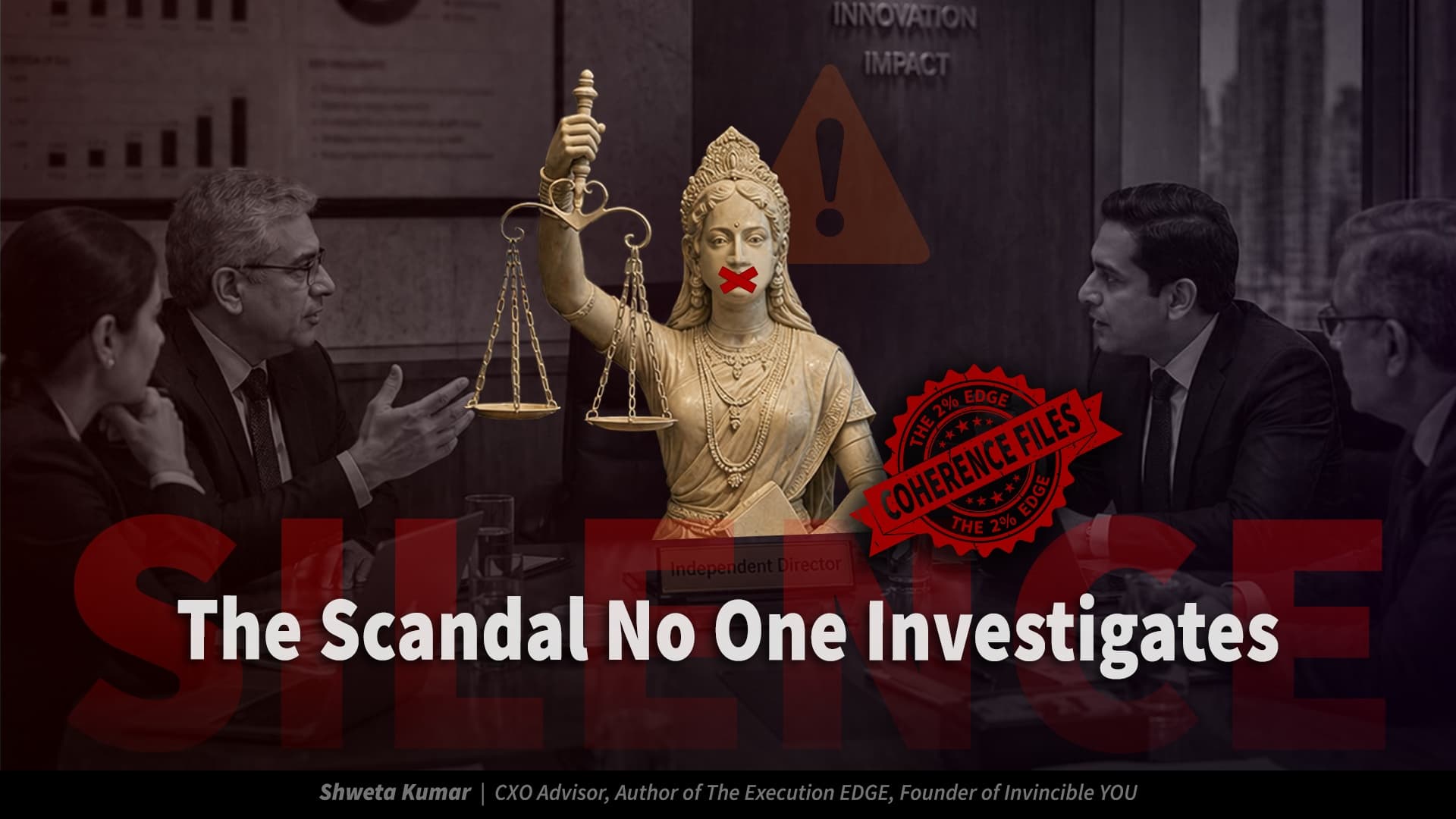
How India Inc.’s strongest governance system is still producing its most dangerous failures
Corporate scandals are easy to recognize in hindsight.
They come with sharp edges eventually resulting in regulatory orders, collapsing valuations, public outrage, leadership exits. Following this the narrative forms quickly: a bad decision was made, a control failed, or a leader overreached that led to the crisis.
But if you rewind far enough, most of these stories don’t begin with a bad decision.
They begin with a moment where that decision could have been challenged—and wasn’t.
A boardroom discussion where something didn’t fully add up. A risk that felt stretched, but still technically acceptable. A whistleblower signal that raised discomfort, but not urgency.
Nothing visibly breaks in that moment.
The system continues. The meeting closes. The minutes are clean.
And yet, that is the origin point, when nothing interrupted the collapse that was about to happen.
Silence, in its earliest form, is indistinguishable from normal functioning.
That is what makes it dangerous.
The system that got everything right
and still missed the point
Over the last fifteen years, India has built one of the most sophisticated corporate governance frameworks in the emerging world.
Post-crisis reforms—after Satyam, IL&FS, DHFL—did what they were supposed to do. They tightened the system. They clarified roles. They strengthened accountability. Independent directors became mandatory. Audit committees became sharper. Disclosures became deeper. Training, databanks, ESG mandates…. layer after layer of structural reinforcement.
By 2025, Indian boards were, by almost every visible measure, compliant.
In fact, 98% of directors say so.
That number should inspire confidence.
It should signal arrival.
Instead, it hides the real story:
In the same system where compliance is near-universal, only 17% of boards actively shape strategy. Over a third of directors admit their role rarely goes beyond management’s proposals. Nearly three-quarters rely almost entirely on information curated by management itself.
Pause on that.
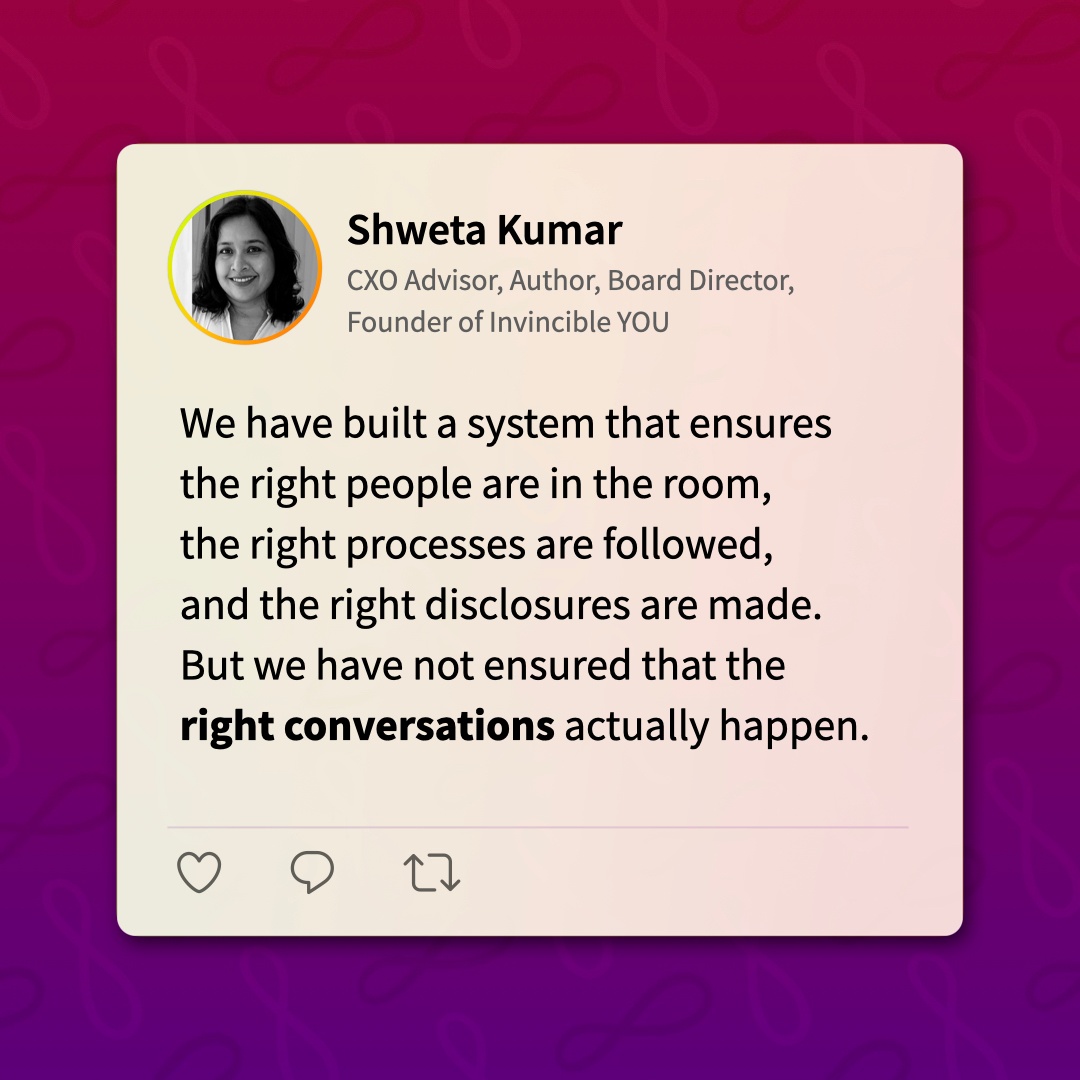
This is not a regulatory failure.
It is something more unsettling:
A behavioural failure inside a regulatory success.
And that is where silence stops being incidental, and becomes structural.
The dark side of silence:
How it actually works
Silence in professional contexts doesn’t look like suppression or feel like fear. It feels reasonable.
It shows up as a question softened at the last moment.
As a concern acknowledged but not pursued.
As a doubt that doesn’t quite justify derailing the discussion.
Each instance is small, defensible, and appears contextual.
But together, they create a pattern that changes how decisions get made.
The onset of silence inside an organization doesn’t remove information.
It filters which information gets traction.
Signals that are inconvenient lose confidence.
Narratives that are clean move faster.
Ambiguity gets deferred until it becomes undeniable.
By the time something crosses the threshold of urgency, the system can no longer decide wisely but has to react immediately.
This is the dark side of silence.
It delays recognition, and makes failure inevitable.
Regulation is raising the bar.
Behaviour is not catching up.
If there is one thing regulators have made clear in recent years, it is this: passive oversight is no longer acceptable.
Independent directors are no longer protected by distance from operations.
“I didn’t know” has stopped being a viable defence.
Across multiple enforcement actions, the message is consistent—diligence is active. Directors are expected to question, verify, interrogate, and independently assess.
The shift is fundamental.
From “trust and verify” to “interrogate and validate.”
But while the regulatory expectation has evolved sharply, the behavioural reality inside boardrooms has not moved at the same pace.
Most directors are still operating within management’s frame of reality.
Most boards are still endorsing more than they are shaping.
Most critical signals are still acknowledged, rather than pursued.
This creates a widening gap.
On one side, a system that demands interrogation.
On the other, a room that still rewards smoothness.
That gap is where the next wave of accountability will land.
What actually leads to the crisis?
We tend to analyse corporate failures through the lens of decisions.
What went wrong?
Who approved it?
Why wasn’t the risk seen?
But that lens is incomplete.
A more revealing question is this:
💭🌱 What made that decision unquestionable in the room?
Was the data too clean to interrogate?
Was the narrative too well-framed to disrupt?
Was the cost of dissent too high to sustain?
In many Indian boardrooms, the answer lies in a subtle calibration that happens over time.
Directors learn what kind of questions are welcome.
How far they can push before the room tightens.
Which concerns are “noted” and which ones are actually explored.
No one announces these rules.
They are absorbed, and then decisions simply don’t get challenged deeply enough.
Where truth stops traveling upward
Every governance system depends on the quality of information it receives.
Not just data but TRUTH (the uncomfortable, unfiltered, sometimes inconvenient version of reality that allows a board to see beyond the narrative being presented).
But truth does not travel automatically.
It depends on channels: Whistleblower mechanisms. Independent audits. Direct engagement with management layers beyond the top.
On paper, these channels exist.
In practice, their effectiveness depends on what happens after the signal arrives.
Is it interrogated?
Is it followed through?
Is it allowed to reshape the board’s understanding?
Or is it acknowledged, contained, and routed back into the same system it questioned?
In many cases, the latter prevails.
The audit committee reviews, but does not persist.
The board notes, but does not escalate.
Management responds, and the response becomes the resolution.
This is where truth stops traveling upward. Even if it is not blocked, it is not carried far enough to travel upward and into action.
Need for the leadership shift to avoid the silent crisis we are sitting on
As we talk, the archetype of the independent director is already changing:
From the early “eminent figure”
to the technically qualified expert
to increasingly, the risk-aware compliance professional.
This evolution is understandable.
As scrutiny rises, so does personal exposure.
Directors are held accountable not just for what they do, but for what they fail to prevent.
The rational response is to operate safely, prepare thoroughly, document rigorously, and avoid positions that could later be questioned.
But this creates a tension:
The work of stewardship requires engagement with uncertainty.
The work of self-protection rewards caution.
And over time, the balance shifts.
Directors become more precise in fulfilling formal obligations, and more restrained in shaping outcomes. Classic leadership drift in its most subtle form.
It is then that we need a real shift in the room we operate in.
How much does it encourage disagreements?
How safe do people feel sharing bad news?
Does a strong dissent still qualify as polite & professional?

When we describe corporate failures as leadership failures or culture failures, we are often pointing to symptoms. The deeper pattern is:
Silence became normal long before the failure.
Functional silence that feels necessary to allow meetings to run smoothly, keep relationships intact, and avoid unnecessary friction…. Until that friction is exactly what was needed.
This is why silence is not just a contributing factor. It is often the root condition and the invisible infrastructure on which poor decisions stand.
Leaders need to start making Silence heard.
The paradox India Inc. is now facing
More specifically, India’s governance system is entering a new phase.
Enforcement is tightening.
Investors are more vocal.
Proxy advisors are more influential.
Expectations from boards are rising sharply.
But the behavioural shift required to meet these expectations is lagging.
The system demands more courage.
The environment makes that courage more expensive.
See the paradox?
In such conditions, silence becomes the safest strategy (not consciously chosen, but consistently reinforced). Over time, it shapes the very outcomes the system is trying to prevent.
What this series will examine
We will not be talking about corporate failures in the conventional sense. It will not focus on what went wrong in isolation.
Instead, it will trace something more fundamental.
Across companies like YES Bank, IndiGo, high-growth startups, and promoter-led mid-caps, we will examine:
Not which decision failed
but what made it unquestionable.
Not where culture broke
but where truth stopped traveling upward.
Not how leadership collapsed
but what is the drift that was widening in silence.
Each case will be different.
Different sectors. Different triggers. Different outcomes.
But beneath them, you’ll see the same pattern appear:
A system that functioned. A board that complied. And a silence that shaped everything in between.
The 2% mirror
Before we get into the series next month onwards, it is worth taking a minute to reflect.
The concept of ‘India Inc’ is not an abstract one. This is a series about the rooms we sit in. The meetings we attend. The moments where we choose (often unconsciously) between raising something and letting it pass.
98% consider those as minor & routine moments,
while 2% recognize the possible drift that it is signalling, and choose to act on them.
In your last few critical discussions:
💭 What did you sense but not pursue?
💭 What did you assume someone else would pick up?
💭 What did you think your team member softened instead of stating clearly?
Silence feels like an absence of action.
But silence decides everything.
Silence is the new scandal.
Stay tuned for the release of the detailed breakdowns.
Or subscribe to the newsletter to not miss the series.
Wishing you invincibility,
Shweta.