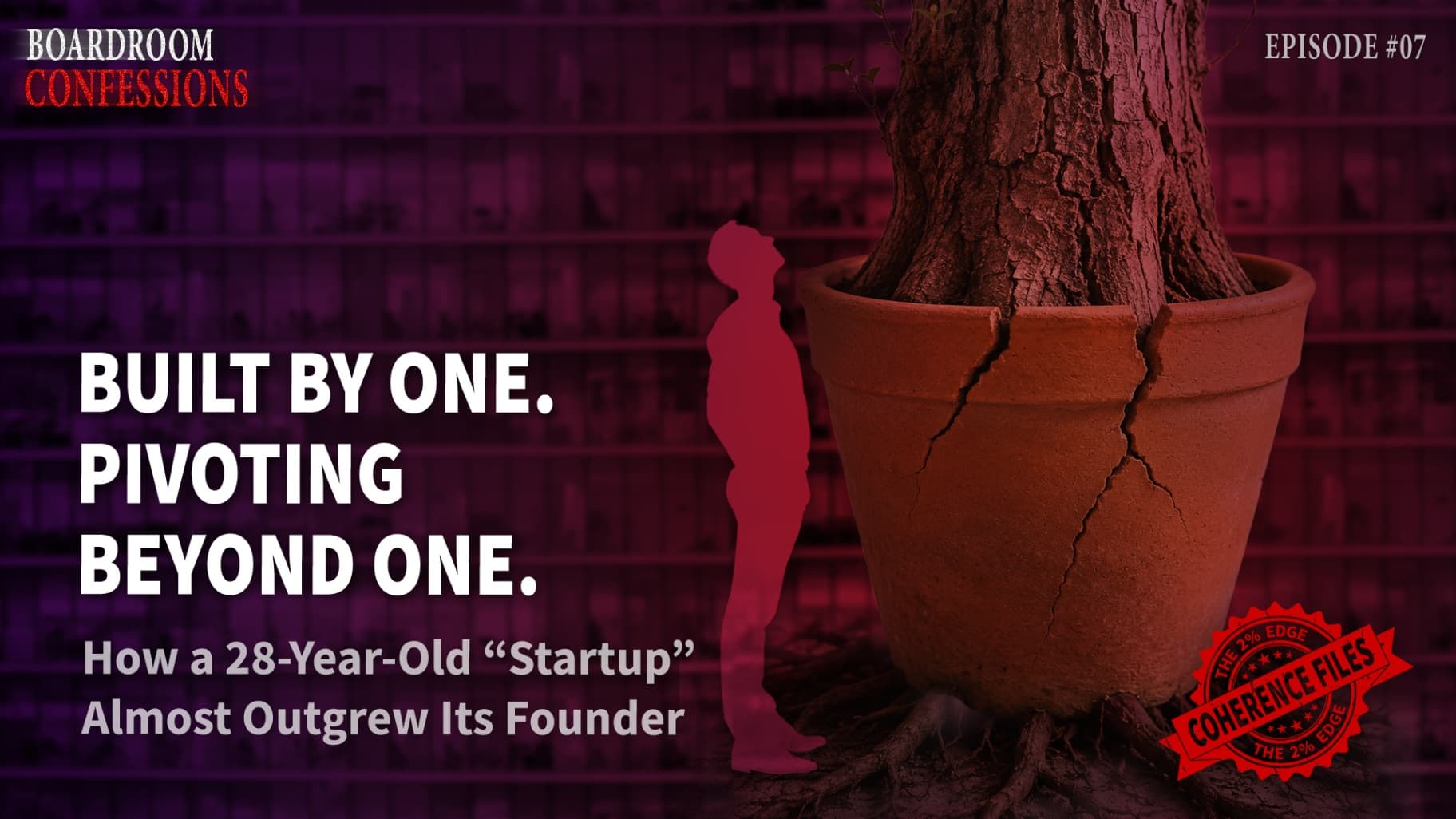
How a 28-Year-Old “Startup” Almost Outgrew the Man Who Built It
He had not slept properly in nineteen years. That was the first thing Aakash Mehta told me — not as a complaint, but as a credential.
We were in his Mumbai office on a Saturday morning in February 2024. Most of the floor was empty. He had asked me to come in on a weekend because, he said, weekdays were “too noisy to think.” What he meant was: weekdays were when his people were there, and he could not be in a room with his people without scanning their screens, joining their stand-ups, walking past their desks twice. “I just like to know what’s happening,” he said. “I’m a hands-on founder. That’s not a flaw. That’s why this company exists.”
His company had begun in 1996 as a small broking and advisory shop above a sweet shop in Kalbadevi. Two desks, three telephones, a fax machine that ran hotter than the room. By 2024, it called itself a “28-year-old startup.” It had eleven hundred employees, offices in eight Indian cities and one in Dubai, a Series D round closed eighteen months earlier, and a digital trading platform that had taken it from being a traditional brokerage to a top-five fintech player. The pivot from a paper-and-relationship business to a mobile-first, algorithmic, customer-acquisition machine had, by every external measure, been one of the more impressive transformations in Indian financial services.
By every internal measure, it was killing him. And it was beginning to kill the company.
“Shweta,” he said, after a long silence in which he checked his phone four times, “I think I’m losing my company. Not financially. We’re growing. But I can feel it slipping away from me. Every time we pivot, fewer people come with me. And I can’t tell anymore if it’s because the pivot is wrong, or because I’m wrong about how to take them through it.”
That single admission became the cornerstone of the work and transformation that unfolded over the next four months.
The Twenty-Eight-Year Startup
There is a particular tenderness reserved for founders who have built a company so long ago that the original co-founders have left, the original product has been retired twice, the original premises have been sold, and yet the founder is still there, still believing the whole thing might collapse if he turns his back. Aakash was such a founder.
He had pivoted the company six times in twenty-eight years. From physical broking to franchise-led broking. From franchise-led to direct retail. From direct retail to online. From online to mobile. From mobile to platform. From platform to “financial super-app.” Each pivot had been, in retrospect, correct. The market had moved every time, and he had moved before it. His instinct for the next thing had been near-uncanny.
Each of the first six pivots had also been a single-location pivot. The company that pivoted from physical to online in 2010 was a company of two hundred and thirty people, almost all of them in Mumbai, almost all of them within a fifteen-minute walk of his office. The pivot from online to mobile in 2017 was managed from one floor of one building. Aakash had developed, across these six pivots, a leadership style perfectly calibrated for transformation in close quarters: he could be in every room, read every face, smell every hesitation, intervene before drift compounded. His pivot success rate of one-hundred percent over twenty-eight years was, in part, a testament to his judgment. It was also a testament to the fact that he had never run a pivot at the scale and dispersion of the seventh.
The seventh pivot — the one we had been called in to support — was different in kind, not degree. The company was now multi-locational, with engineering in Bengaluru, customer operations in Hyderabad, distribution in eight cities, the founder and the original leadership team still in Mumbai, and a small but growing offshore office in Dubai serving NRI clients. The pivot under discussion was from “financial super-app” to an AI-led, advisory-first model in which human advisors would be augmented by machine learning across portfolios, life events, and tax planning. It was a credible pivot. The data supported it. The board supported it. The CTO had built a working prototype.
What was different was that, for the first time in twenty-eight years, Aakash could not see his company.
He could not walk past the engineers’ desks because the engineers were nine hundred kilometres away. He could not “feel the temperature” of customer operations because it was in another city, in another building, run by a head of operations he had hired only fourteen months earlier. He could not pull a laggard aside in the corridor because there was no shared corridor. And his Series D investors had told him, gently but unambiguously, that the company would not survive the next pivot if it remained as founder-centric as it had been.
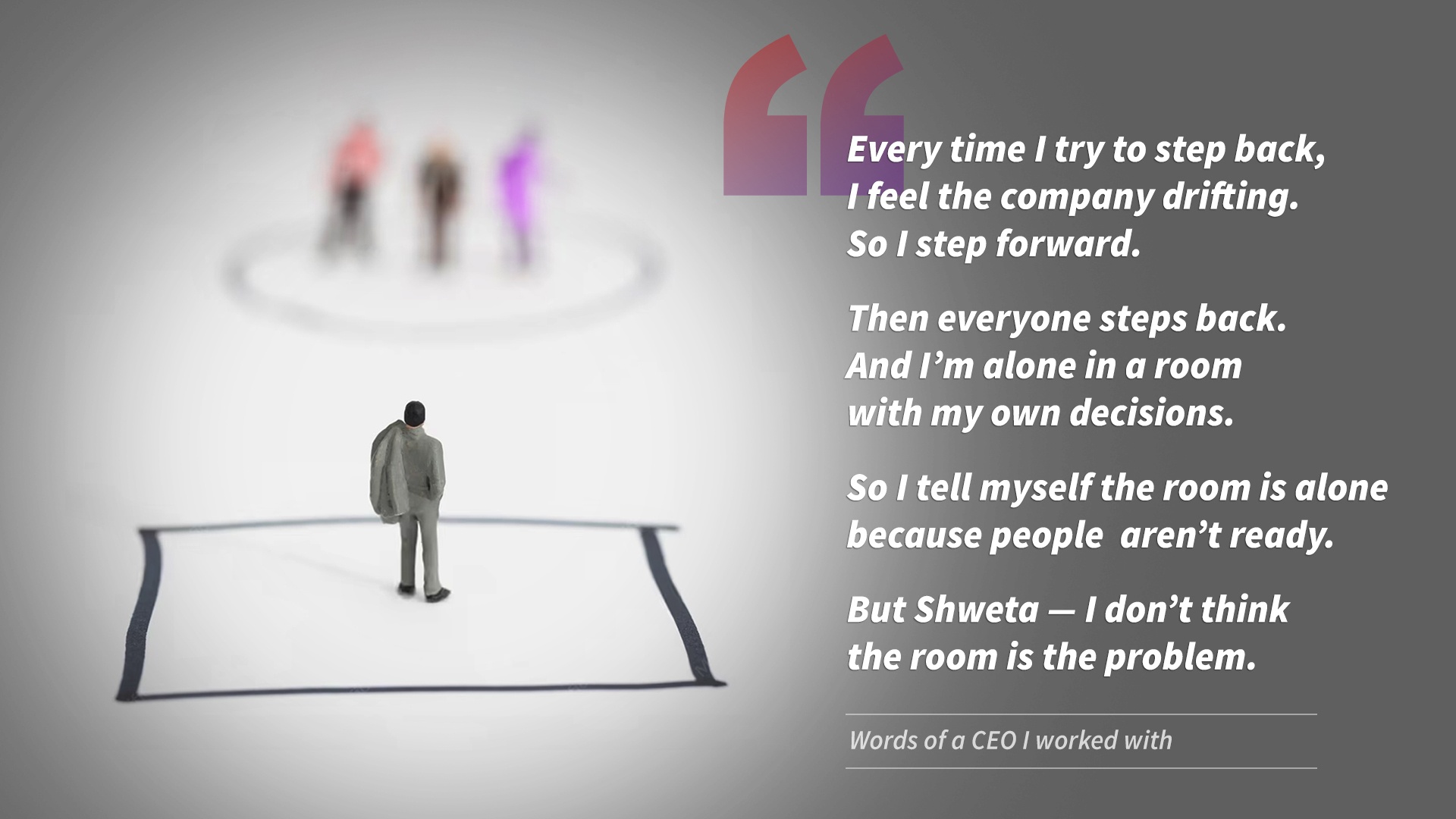
“I have built something that has outgrown the way I built it,” he said in our second conversation. “I know that intellectually. I cannot accept it emotionally. Every time I try to step back, I feel the company drifting. So I step forward. And then everyone steps back. And then I’m alone in a room with my own decisions. And then I tell myself the room is alone because the people aren’t ready. But Shweta — I don’t think the room is the problem.”
That sentence — the room is alone because the people aren’t ready — would become the diagnostic frame for everything that followed.
The Drift Beneath the Pivot
The numbers shown in the exhibits below combine diagnostic patterns from multiple founder-led engagements with companies undergoing late-stage pivots in scaled, multi-locational contexts. Aakash is a composite character, drawn from work with two organisations in particular — one a financial services platform that pivoted from a traditional broking business to a digital-first model, the other a learning technology company that scaled from a single-city Series A start-up to a multinational Series D. Identifying details have been altered. The metric ranges, intervention design, and circuit profiles reflect real engagements.
Over four weeks, we ran the BRIDGE diagnostic across Aakash’s top forty-two leaders, the DriftX execution indicator measurement, and fifty-four anonymous pulse interviews spanning all three primary Indian locations and the Dubai office.
The trust circuit map was the most asymmetrically distributed pattern I had seen in three years of running the diagnostic.
Exhibit 1 — BRIDGE Trust Circuit Scores
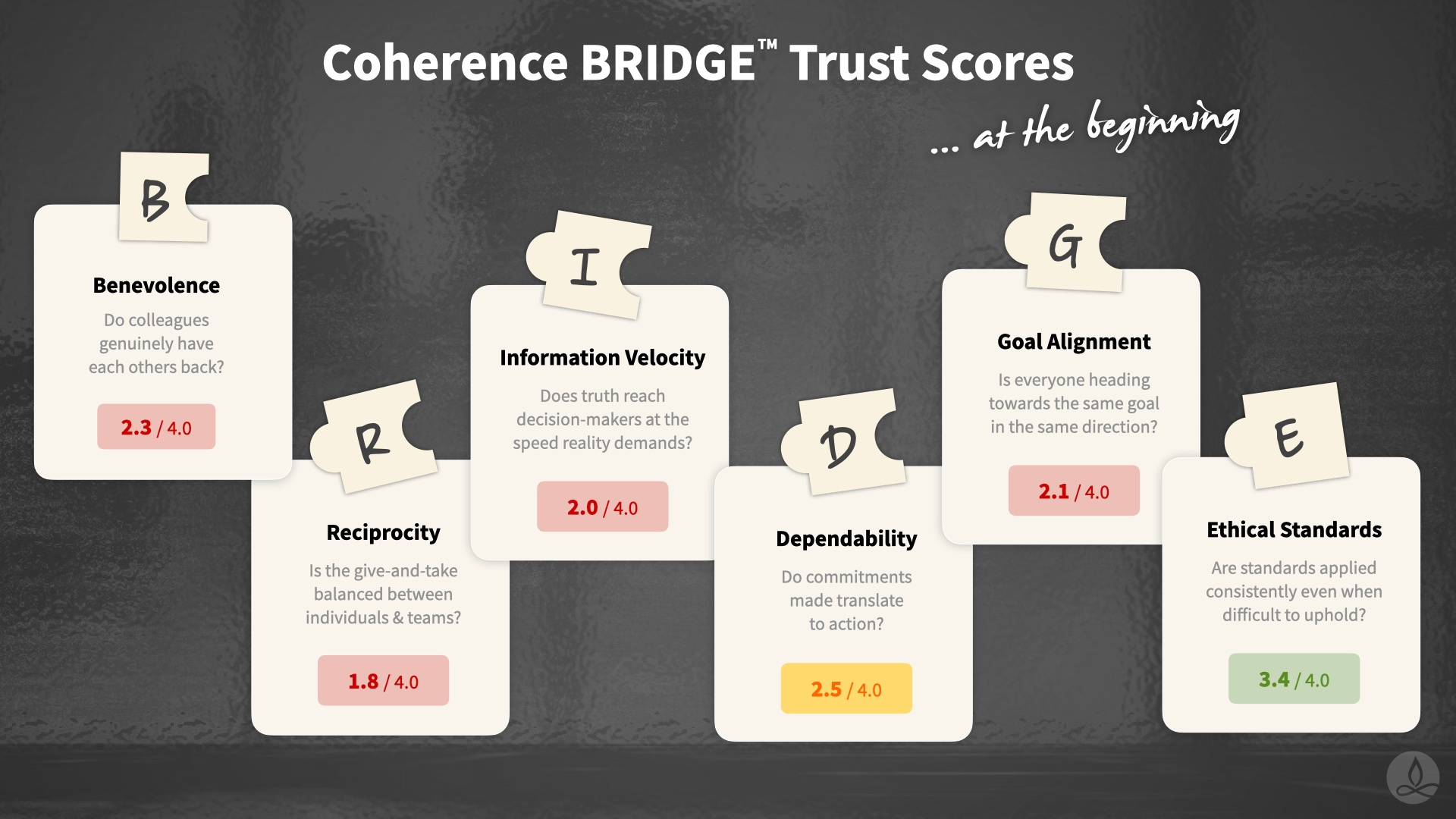
Scale: 1.0–4.0. 🔴 Red < 2.5 | 🟡 Amber 2.5–3.0 | 🟢 Green > 3.0. The asymmetry across locations and tenure cohorts at baseline was significant: leaders in Mumbai who had worked with Aakash for more than seven years scored an average of 3.2 on Benevolence, while leaders in Bengaluru and Hyderabad with less than three years of tenure scored 1.7. The aggregate scores below mask the bimodal distribution, which itself was a finding.
Exhibit 2 — DriftX™ Execution Indicators
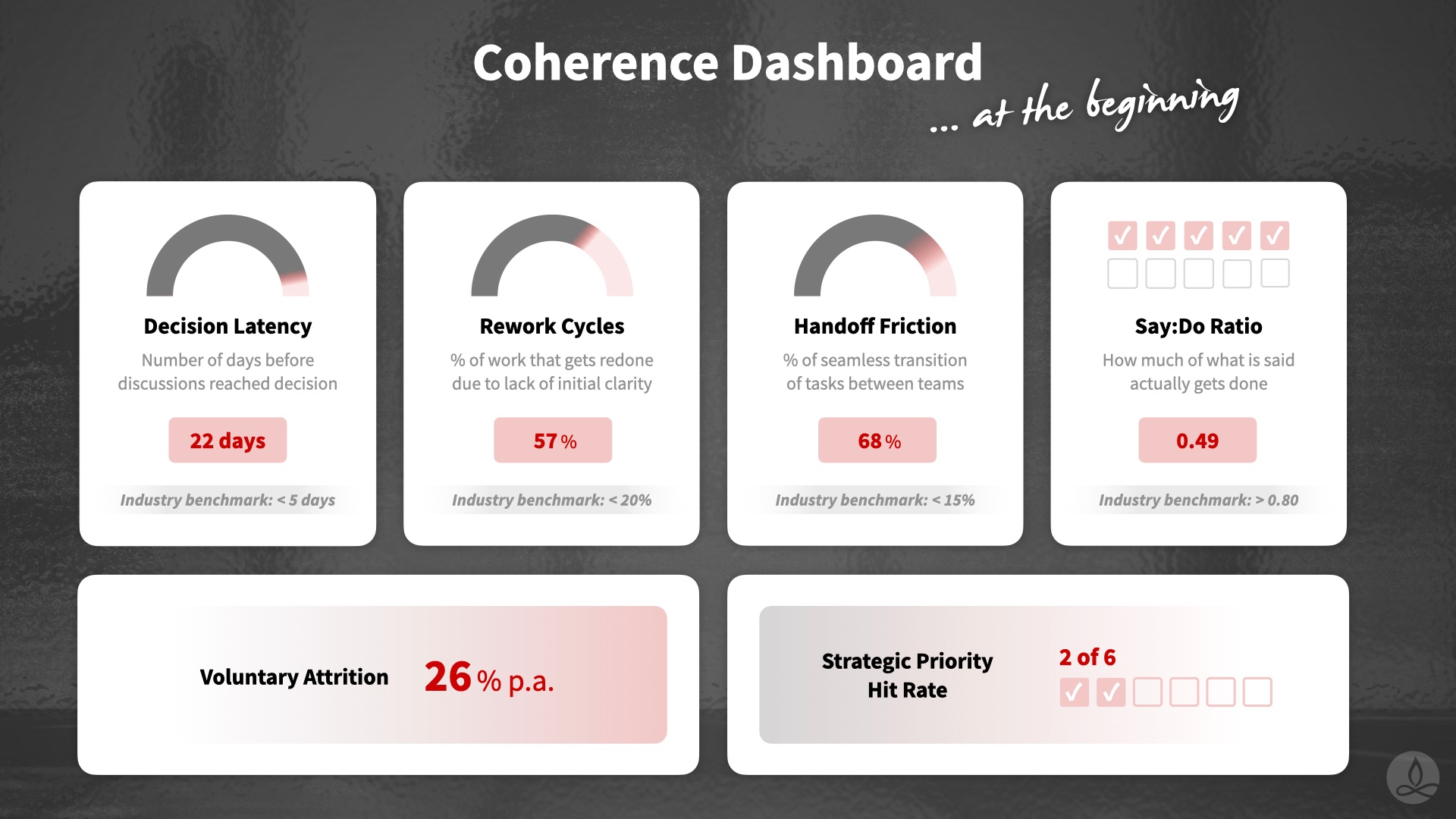
A note on what these two exhibits measure together.
The BRIDGE circuit scores capture perceived trust — what people in the system believe and feel about how the leadership operates. The DriftX indicators capture actual execution behaviour — how long decisions take, how often work is reworked, what proportion of stated commitments are met. The Coherence Bridge™ framework holds that these two layers are causally linked but not identical: perceived accountability shapes the discretionary behaviour that produces execution velocity, but actual execution outcomes feed back into the perceived trust map. In Aakash’s case, the two layers tracked one another with unusual tightness. As Reciprocity and Information Velocity perception scores rose, decision latency and rework dropped on a roughly parallel curve. This is the pattern the framework predicts when interventions are coherent: trust perception leads, execution follows, and execution success then reinforces trust perception. The distinction matters because executive teams sometimes try to fix execution metrics directly — speeding up meetings, mandating shorter review cycles — without addressing the perceived trust underneath. Those interventions produce short-term compliance and longer-term regression. The Coherence Bridge sequencing is deliberate: repair the trust circuits, and the execution indicators move with them.
The qualitative data confirmed, with painful clarity, the shape of the wound.
“Aakash trusts the people he can see. That used to be all of us. Now it’s about thirty people. The other thousand of us are managed by proxy — through dashboards he doesn’t read consistently and through second-hand reports from the thirty people he does trust.”
— Senior leader, Bengaluru, 2 years’ tenure
“Every pivot we’ve done, he’s announced and explained beautifully. What he hasn’t done is told us what is not changing. So we don’t know what to hold on to. We just hold on to him.”
— Director, Mumbai, 11 years’ tenure
“I joined a Series D fintech. I work in a Series A founder’s head. Those are not the same company.”
— Head of Function, Hyderabad, 14 months’ tenure
“He says he wants us in the office because he trusts us. But coming to office is the trust. The trust isn’t built in the office. The office is where the trust is consumed.”
— Engineering manager, Bengaluru
The last quote, from a thirty-one-year-old engineering manager who had never met Aakash in person, was the one that shifted my understanding of the engagement. It was not a complaint. It was a piece of organisational philosophy that the founder had not yet developed.
The Six Circuit Breakdowns:
The Anatomy of a Founder Who Cannot Let Go
The BRIDGE framework, drawing on the foundational Mayer–Davis–Schoorman trust model and extended into six circuits calibrated for senior leadership team dynamics, gave us the structural language for what was happening. In Aakash’s case, the central diagnostic insight was that trust was not absent — it was rationed. Rationed by tenure, by physical proximity, and by the founder’s nervous system.
Benevolence Circuit Drift — Score: 2.3 / 4.0
The benevolence circuit measures whether people feel their leader genuinely has their long-term interests at heart. For Aakash’s longest-tenured colleagues, this was almost unquestioned. He had carried them through three pivots, two near-collapses, and a period in 2008 when he had personally taken a salary cut so the team would not feel the cash crunch.
For everyone hired after 2020 — which, after a Series D and aggressive hiring, was now seventy-three percent of the company — the benevolence experience was different. They knew, abstractly, that he was a “good person.” They had not experienced it. What they had experienced was a founder who scrutinised their work without context, who joined Slack channels at midnight to ask sharp questions, and who measured their commitment by their willingness to be in the Mumbai office on Tuesdays.
Care, when it cannot be experienced, is just a story other people tell. The newer cohorts had not lived the story. They had only inherited the standards.
Reciprocity Circuit Drift — Score: 1.8 / 4.0 (Lowest in diagnostic)
This was the bleeding wound, and it was specifically a pivot wound.
Aakash’s pivots were brilliant strategic moves. They were also, almost without exception, his pivots. He would arrive at a leadership offsite with the next direction already substantially decided in his head. He would present it eloquently, invite challenge, listen attentively to objections — and then, after a period of consultation that felt genuine to him and theatrical to the leadership team, proceed with what he had already decided.
His leadership team had learned to over-contribute in execution and under-contribute in direction-setting. They poured themselves into making each pivot work. The pivots succeeded. And each success deepened the founder’s belief that his judgment was the indispensable input, which deepened the team’s belief that their direction-setting input was the dispensable one.
The invisible ledger read: We give him our hands. He gives us his head. We are not building together. We are building under him.
When the seventh pivot — the AI-led advisory pivot — was announced, three of his most senior leaders did not push back. Not because they agreed. Because they had learned that pushing back was a ritual that did not change outcomes. The reciprocity failure was therefore also an information failure: the dissent was not visible, because it had been trained out of the system.
Information Velocity Circuit Drift — Score: 2.0 / 4.0
In Aakash’s organisation, information moved at two speeds. Inside the founder’s inner circle of thirty, information moved fast and unfiltered. Outside that circle, information moved slowly, through translators, with pre-emptive smoothing.
The Bengaluru engineering team had built an elaborate cultural architecture for this: bad news was first surfaced to a senior engineering manager, who would frame it for the engineering head, who would frame it for the CTO, who would decide whether and how to bring it to Aakash. By the time the founder heard about a critical platform stability issue in October 2023, his teams in Bengaluru had been working on it for nineteen days. He believed this delay reflected incompetence. The diagnostic suggested it reflected the rational economics of his own response patterns.
Pivots accelerated this dynamic. Each pivot reset what was “good news” and what was “bad news” inside the company. After the AI-advisory pivot was announced, things that had been celebrated three months earlier — strong human-advisor performance metrics, growing branch revenues — were suddenly suspect. Teams stopped surfacing them. The information system became a mirror reflecting back to the founder whatever the most recent pivot had defined as success.
Dependability Circuit Drift — Score: 2.5 / 4.0
Aakash’s say-do ratio at baseline was 0.49. This was, in many ways, the most painful number in the diagnostic, because Aakash was not a man who broke promises. He was a man whose promises kept being overtaken by the next pivot.
Six months earlier, he had committed to a specific architecture for the customer operations function. Three months later, the AI-advisory pivot had rendered the architecture obsolete. The Hyderabad team, which had executed against the original commitment with precision, found their work quietly de-prioritised. No one had told them their work was obsolete. No one needed to. The new pivot’s gravity made their work weightless.
This is the dependability problem specific to fast-pivoting founders: the commitments are not broken. They are outrun. The teams executing against them are not betrayed by malice. They are betrayed by velocity. And the felt experience, for them, is identical to broken trust.
Goal Alignment Circuit Drift — Score: 2.1 / 4.0
When we asked Aakash’s top forty-two leaders to articulate the company’s three strategic priorities, we received twenty-nine distinct answers.
Twenty-nine. From forty-two people who reported directly or one-removed to a single founder who had communicated his strategy obsessively, through every channel available, for the past eighteen months.
The cause was not a communication failure. It was a pivot accumulation failure. The company had pivoted seven times in twenty-eight years, and three times in the last four. Each pivot had layered new priorities over old ones without explicitly retiring the old ones. The Mumbai relationship-managers were still optimising for relationship depth. The Bengaluru engineering team was optimising for platform velocity. The Hyderabad operations team was optimising for cost efficiency. The Dubai team was optimising for AUM growth. None of these were wrong. They were the residue of seven different historical pivots, all of which had asked the company to add a priority and none of which had asked it to drop one.
They were not climbing different mountains. They were trying to climb seven mountains simultaneously, with one of them being the mountain they were climbing right now and the other six being the ghost mountains of pivots past.
Ethical Standards Circuit — Score: 3.4 / 4.0 (Comparatively strongest)
Aakash’s ethical standards circuit was the strongest part of the diagnostic, and it was the foundation on which everything else would be rebuilt. Across all locations and all tenure cohorts, his integrity was not in question. People believed he was a fundamentally honest man, that he meant well, that he was not self-serving in a regulatory or financial sense. The financial services context — heavily regulated, deeply scrutinised, built on the trust of millions of retail customers — had calibrated him to a high standard, and he had never wavered.
This ethical floor was the reason the engagement was possible at all. As trust research consistently suggests, when integrity holds, recovery from other circuit failures is significantly faster. The team’s exhaustion was not cynicism. It was tiredness in the presence of a man they still believed in. That distinction was everything.
The Heart of the Pivot Dilemma
Six weeks into the engagement, I asked Aakash a question that changed the engagement’s trajectory.
“Aakash,” I said, “tell me about the pivot you didn’t do.”
He looked at me as if I had spoken in a language he had partially forgotten.
“I don’t understand,” he said.
“In twenty-eight years, you’ve pivoted seven times. Tell me about a time you considered a pivot and decided not to make it.”
He was silent for nearly four minutes. I watched him look out the window of the conference room, towards the Arabian Sea, with the expression of a man searching his own memory for evidence of restraint.
“I can’t think of one,” he said, finally.
“Aakash,” I said, “that is the dilemma.”
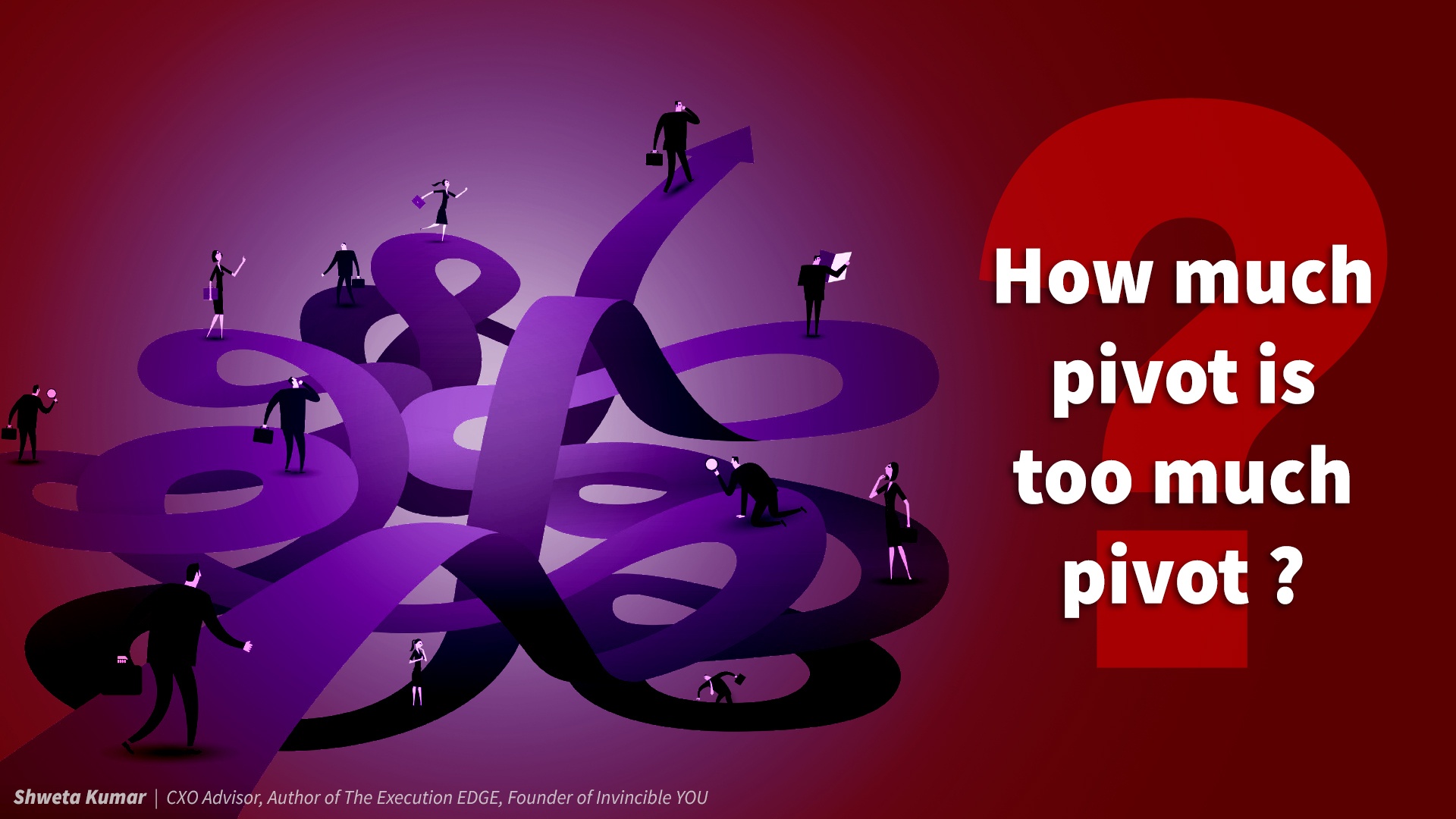
The dilemma was this: Aakash had built his identity, and his company’s identity, on the capacity to pivot. Every pivot had succeeded. Every pivot had been celebrated. Every pivot had reinforced the belief that pivoting was strength. What he had never developed was the capacity to not pivot — the discipline of holding still when the market tempted him to move, the muscle of distinguishing a necessary pivot from an anxious one, the wisdom of asking whether the pivot was for the company or for himself.
His pivots were brilliant. They were also, increasingly, addictive. Each new direction gave him the founder’s high — the rush of seeing the future before others did, the intoxication of being indispensable to the next chapter. And each pivot, by resetting the company’s priorities, reset the basis on which he had to trust other people. Every pivot was an opportunity to start trusting again from scratch — which meant, in practice, not trusting at all.
This was the unspoken architecture of his attachment to the company. He could not let go because he kept changing what there was to let go of.
The dilemma was not whether the seventh pivot was correct. The data was clear that it was directionally right. The dilemma was that, until he could distinguish a necessary pivot from a self-soothing one, he could not lead a multi-locational company through it. Because in a multi-locational company, the pivot is not a moment. It is a sequence of trust transactions in places the founder will never set foot.
The Trust-versus-Presence Dilemma
The other dilemma, woven through every conversation with Aakash, was the question of physical presence.
He was, in early 2024, one of a generation of Indian founders genuinely conflicted about hybrid work. He had read all the arguments. He understood, intellectually, that high-performing distributed teams were not only possible but advantageous. He had met other founders who had built nine-figure businesses with engineering teams across four time zones. He believed them.
He did not believe it for his own company.
“I need to see them, Shweta,” he said in one of our late-evening sessions. “Not because I don’t trust them. Because I trust them more when I see them. There’s something in being in the same room. The casual conversations. The body language. The way someone fidgets when they’re hiding bad news. I cannot read these things on a Zoom call. And if I can’t read them, I can’t lead them.”
This was not, in itself, a wrong instinct. The information bandwidth of in-person leadership is higher. What Aakash had not yet articulated was the cost of trying to scale that instinct across a multi-locational, multinational organisation.
The cost was that he could only fully lead the people he could see. And in a company of eleven hundred people, the people he could see were a small minority. The rest were either leading themselves badly because they were not led at all, or being micro-led through technology by a founder whose instincts had been calibrated for in-person trust.
The “come back to office” mandate, which his executive team had been pushing for six months and which he had been emotionally aligned with but operationally unable to implement, was a symptom of this confusion. The mandate was not really about productivity. It was about trust calibration. He wanted everyone in the office because he had not yet built the trust infrastructure required to lead them when they were not.
The work, therefore, was not to settle the office-versus-remote question. It was to build the trust infrastructure that made the question less existential. To replace physical presence as the primary trust signal with a portfolio of substitutes: structured rhythms, named accountabilities, decision rights, ritualised information surfacing. To build, in effect, a way of being a founder that did not depend on line of sight.
The Founder’s Deepest Confession
In our eighth session, Aakash said something I have heard, in different words, from almost every founder I have worked with at his stage. But he said it more directly than most.
“I want help. I have always said I want help. I have hired senior people. I have given them titles. I have sent them to executive education programmes. I have, on paper, delegated. And then, every time something goes wrong — and sometimes when it doesn’t — I take it back. Because the truth is, Shweta, I don’t believe anyone else can hold this baby the way I hold it. I know that’s wrong. I know it’s the thing that’s killing the company. But I don’t know how to not believe it. The company is not an asset to me. It’s a child. And you can’t co-parent a child with someone you haven’t fully accepted as a parent.”
That last sentence sat in the room between us for a long time.
It was the most accurate articulation I had ever heard of the founder’s particular agony. The willingness to delegate authority is not the same as the willingness to share parenthood. Delegation is administrative. Co-parenting is identity-relinquishing. And no amount of organisational design can produce co-parents if the founder has not accepted, in his deepest layer, that other people are also parents of the thing he started.
The work, from that session forward, became different. We were no longer designing protocols to reduce his information load or improve decision speed. We were designing rituals to help him grieve — yes, grieve — the version of his company in which he was the only parent, and to welcome the version in which he was the founding parent, but not the only one.
This was not soft work. It was the most operationally consequential work we did.
Details in the next episode of Boardroom Confessions.
Stay tuned.
Note: Names, industry details, and identifying information have been altered to preserve confidentiality. Aakash is a composite drawn from engagements with founder-led, late-pivot, multi-locational organisations. The diagnostic patterns, intervention design, and metric ranges combine observations from multiple senior leadership engagements using the BRIDGE™ framework, the DriftX™ diagnostic system, and the Coherence Code™ leadership framework.