
How a Leader Let Go to Build Real Ownership
In the last episode, we saw how Subroto’s pursuit of excellence slowly turned into a constraint — how his need to be right, to refine, to step in… became the very reason his team stopped owning.
His greatest strength had become the system’s quiet limitation.
And then came the moment of reckoning, because once you see the trap, you can’t unsee it.
The harder reflection for any leader isn’t identifying what’s going wrong around me, but *what part of me might be creating it?
*This is where most leaders pause, and a few choose to act.
In this episode, we pick up from that exact moment.
🌱 What does it actually take for a leader to step back… when everything in them wants to step in?
🌱 What shifts when control loosens, but accountability doesn’t?
🌱 And how does a team begin to reclaim ownership after years of over-guidance?
Subroto didn’t just recognize the trap.
He chose to break it.
Here’s how that transformation unfolded.
What Was Really Happening
Just before we get into what changed, it’s worth pausing a minute to understand what was actually happening beneath the surface. What we saw until now (over-involvement, low ownership, filtered information) were just the visible symptoms.
The real story was running deeper.
The systems psychodynamics lens reveals layers beneath the observable behaviour that explain why Subroto’s patterns were so tenacious and so invisible to him.
Performance Theatre as Survival Mechanism
Subroto’s hyper-visibility—the early arrivals, the over-prepared agendas, the constant demonstration of mastery—was not arrogance. It was a performance designed for an audience of one: the version of himself that still believed he might be found inadequate. The theatre protected him from the anxiety of not knowing. And it communicated to his team, with perfect clarity, that their performance was always being watched.
Projection and the Excellence Transfer
In psychodynamic terms, Subroto was projecting his own standards onto his team in a way that made their work both about the work and about him. When they succeeded, it confirmed his capability as a leader. When they fell short, it threatened his self-concept. This is the most damaging form of over-investment in team performance: it transforms colleagues into extensions of the leader’s identity management.
The Transition Wound
The CHRO-to-COO move is one of the more challenging identity transitions in corporate leadership, precisely because it requires moving from a domain of deep expertise to one of breadth. Subroto had built his identity almost entirely on functional mastery. The COO role required him to lead domains—supply chain, technology operations, enterprise transformation—where he could not be the most expert person in the room.
He had responded by making his process excellence—his rigour, his frameworks, his analytical discipline—the thing he imposed on every domain. It was a brilliant adaptation. It was also suffocating the domain experts he needed to trust. And it was generating, silently and systematically, the executive drift that was making the conglomerate’s growth ambitions undeliverable.
From Fragmented Identity to Coherence
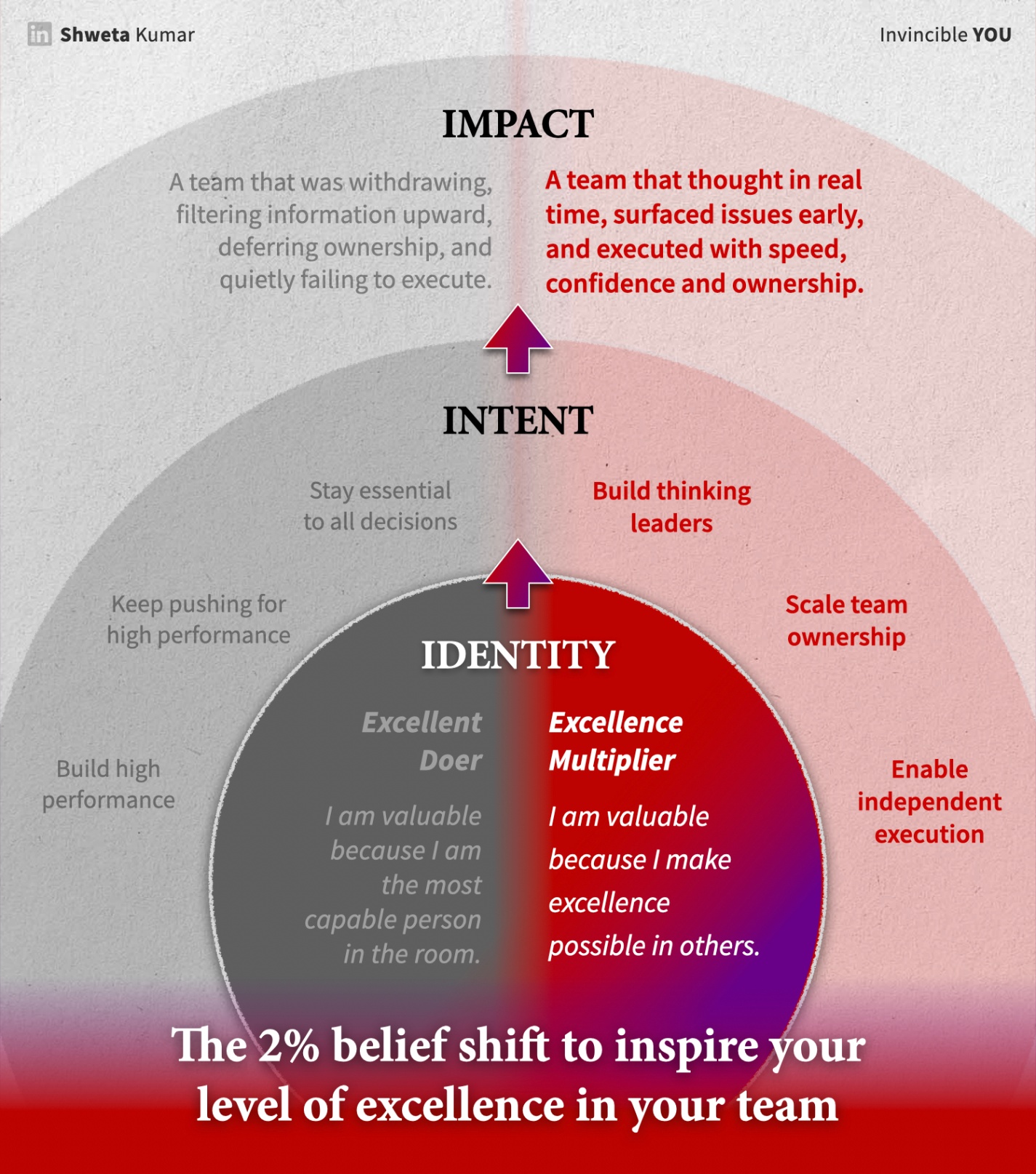
The Coherence Code™ framework holds that sustainable leadership effectiveness requires alignment across three domains: Identity (who the leader believes themselves to be), Intent (the choices they make based on that identity), and Impact (what the organisation actually experiences as a result). When these three are misaligned, no protocol or system can produce durable change, because every intervention is being run through an incoherent engine.
In Subroto’s case at baseline, the misalignment was stark:
-
Identity: over-indexed on visible, attributable excellence—‘I am valuable because I am the most capable person in the room.’
-
Intent: genuinely wanted to build a high-performing team and deliver the growth mandate.
-
Impact: a team that was withdrawing, filtering information, losing authorship, and quietly failing to execute.
The gap between intent and impact was not dishonesty. It was a coherence failure: the identity driving his behaviour was producing the precise opposite of what his intent required. Until that misalignment was named and addressed, no trust circuit intervention would hold, because the leader’s internal architecture would keep regenerating the same patterns regardless of the protocols in place.
The intervention work—the Identity Audit, the Excellence Fast, the Authorship Protocol—was not about changing Subroto’s values or competence. It was about re-anchoring his identity in something that did not require constant external proof: the conviction that making others excellent is itself the highest form of leadership excellence. As that internal re-anchoring took hold, the trust circuits responded—not because the protocols were well-designed, but because the engine running them had changed.
By endpoint, the coherence picture had shifted:
-
Identity: increasingly anchored in ‘I am valuable because I make excellence possible in others.’
-
Intent: build a team that is genuinely better for having worked with him.
-
Impact: trust circuit scores improved across all six dimensions; execution indicators moved in lockstep.
Building the Coherence Bridge: The Interventions
The work with Subroto was unlike any engagement I’ve run, because the central intervention was not organisational. It was personal. The trust circuit repair could only follow the internal coherence repair. The engagement unfolded in three phases, each building on the last.
Phase 1 Weeks 1–3 Diagnostic — Mapping the Drift
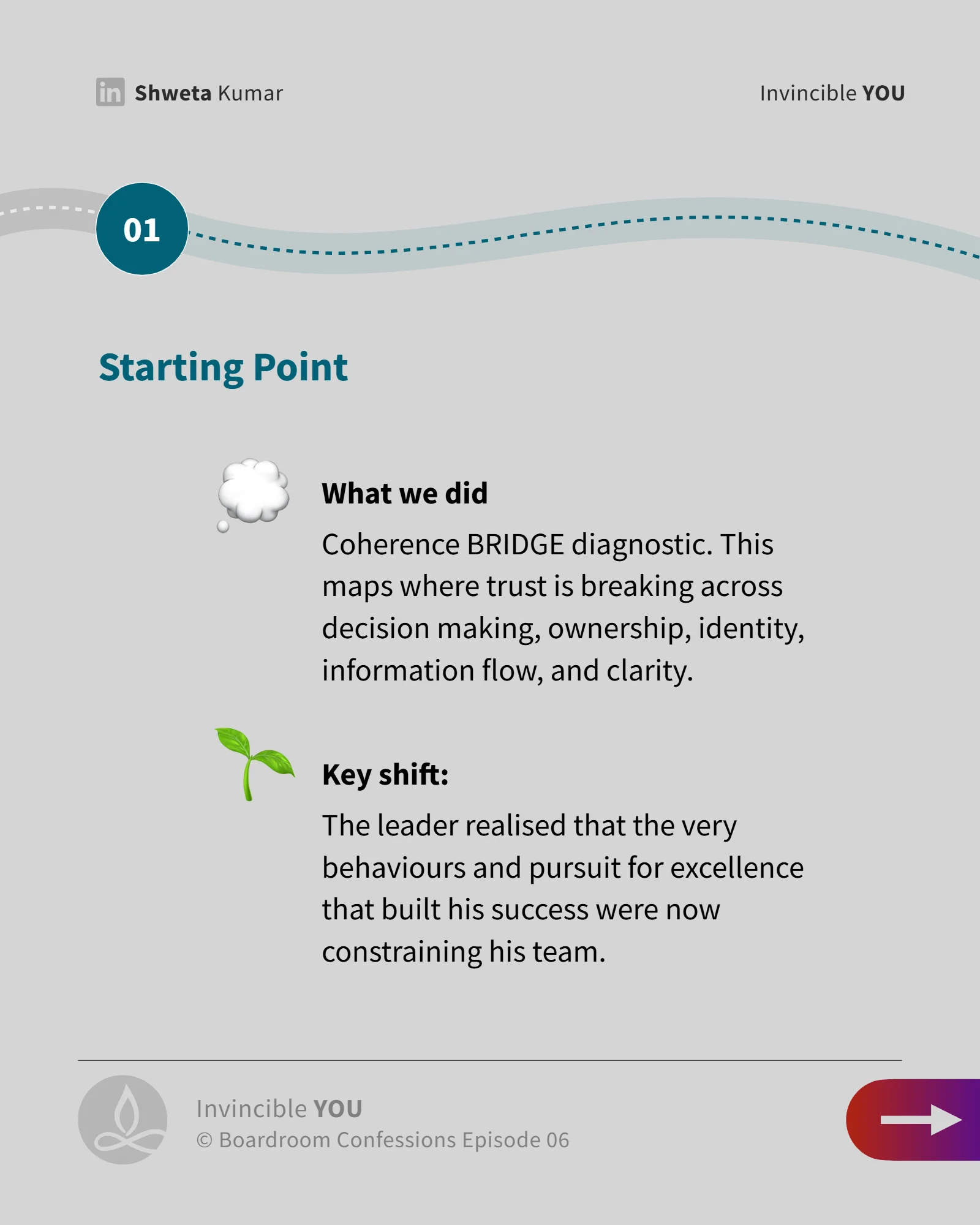
The diagnostic phase combined the BRIDGE trust circuit assessment, the DriftX execution indicator measurement, and forty-two anonymous pulse interviews across Subroto’s direct reports and their teams. It concluded with the recognition session six weeks in, where the findings were presented and the pattern named.
Phase 2 Months 1–6 Identity and Trust Circuit Repair
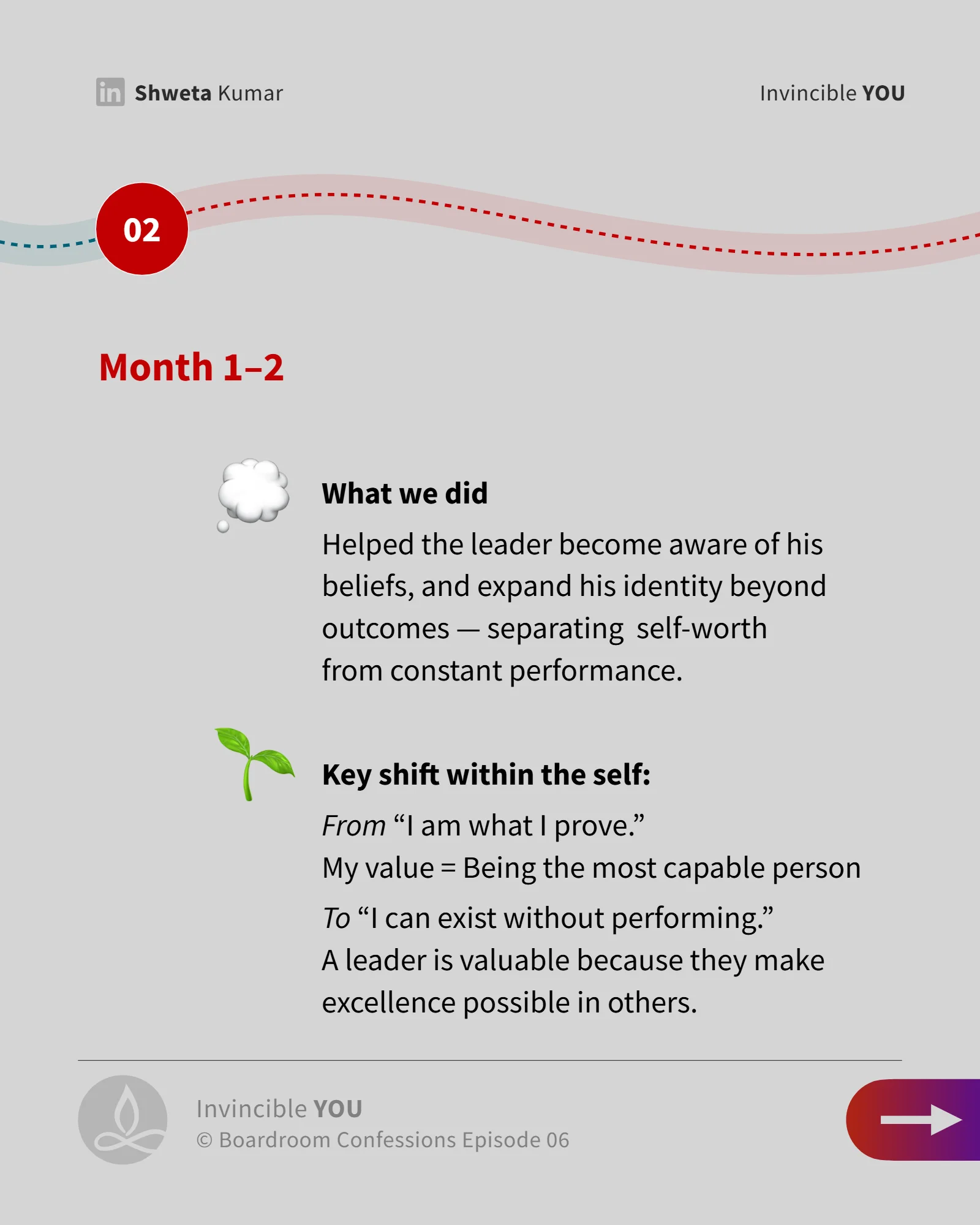
Month 1–2: The Identity Audit — Who Are You When You Are Not Excellent?
We began with what the Coherence Code™ calls Identity Clarification—a structured examination of the leader’s self-concept across personal, relational, and collective levels. For Subroto, this was disorienting.
His personal-level identity was entirely achievement-indexed. His relational identity was expressed through the competence of the people around him. His collective identity was as the smartest person in the function.
None of these identities were wrong. All of them were incomplete. And the absence of an identity that did not require proof was the gap through which impostor anxiety entered every interaction.
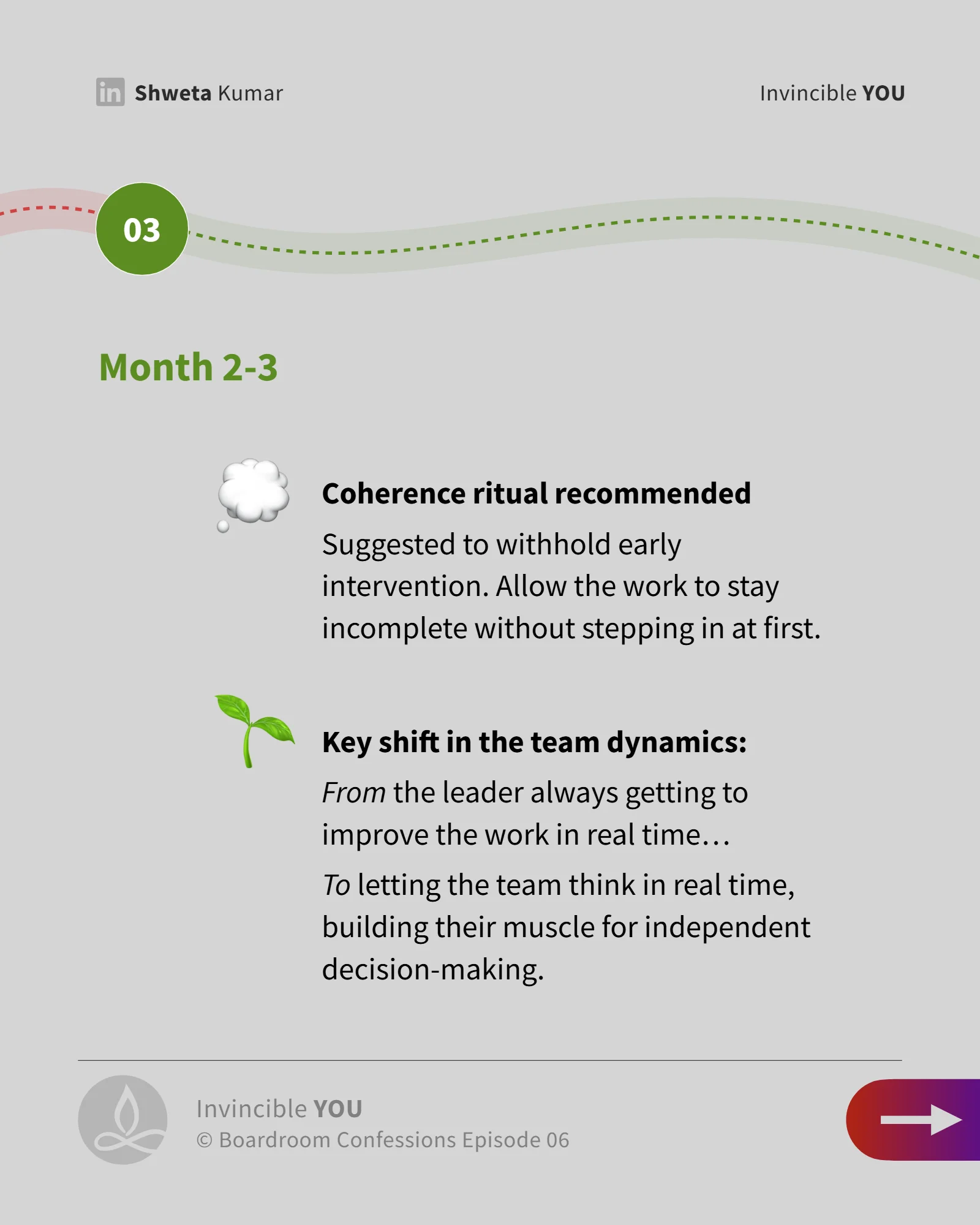
The first eight weeks involved what I called the “Excellence Fast”—a disciplined practice of withholding his instinct to improve, correct, or enhance his team’s work before it was complete. He was asked to receive work-in-progress as information rather than as evaluation material. The discomfort was immediate and significant. The choice he faced was not comfortable: continue the performance theatre that had made him safe for twenty-three years, or risk sitting with the anxiety of being genuinely invisible in the room long enough to see what his team could produce without him.
“I sat in a review last Tuesday and watched Priya present an analysis I could see three problems with in the first four minutes. I said nothing. I nearly had a physical reaction. But then something extraordinary happened—Karan caught one of the problems himself. And the pride on Priya’s face when the team solved it together… I realised I had been stealing that from them for eighteen months.”
Month 3–4: The Reciprocity Reset — Returning Authorship
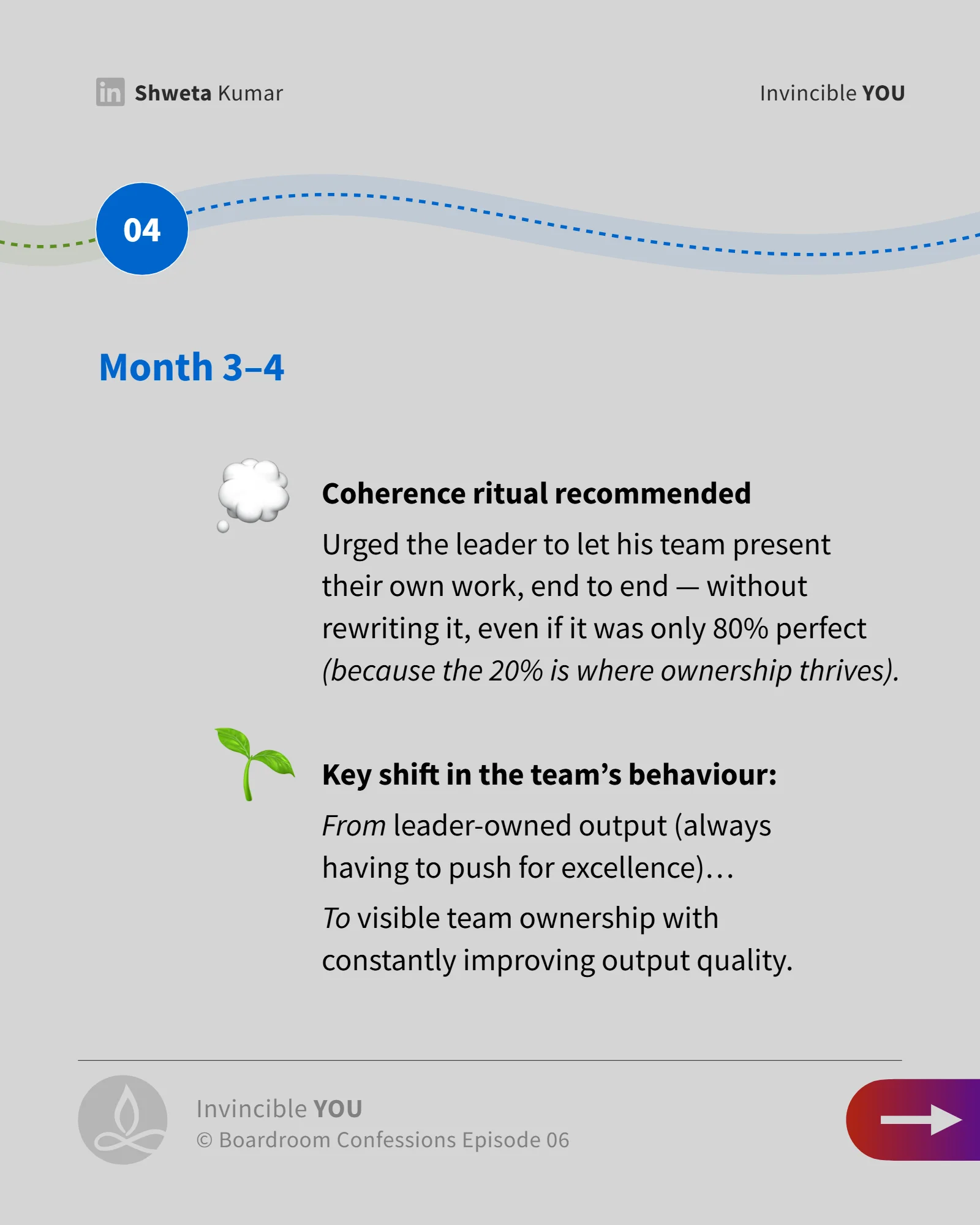
The reciprocity circuit required a structural intervention alongside the personal one. We introduced the Authorship Protocol: a simple, non-negotiable rule that any work originating from a team member’s thinking would be presented in their words, under their name, with Subroto’s role explicitly defined as sponsor rather than author.
The first serious test was a board presentation on operational efficiency. Subroto’s instinct was to review, rewrite, and refine the deck over a weekend. Instead, he asked his Head of Strategy to present the analysis directly to the board, introduced only by a two-minute contextual framing from Subroto. This was a genuine dilemma: the board expected COO-level ownership of the content, and the governance culture rewarded visible executive command. Choosing to step back was not safe.
The board asked excellent questions. The Head of Strategy answered them. Subroto said almost nothing for forty-five minutes.
That evening, he called me: “The work held up without me. I keep thinking I should feel redundant. Instead, I feel… relieved? Is that strange?”
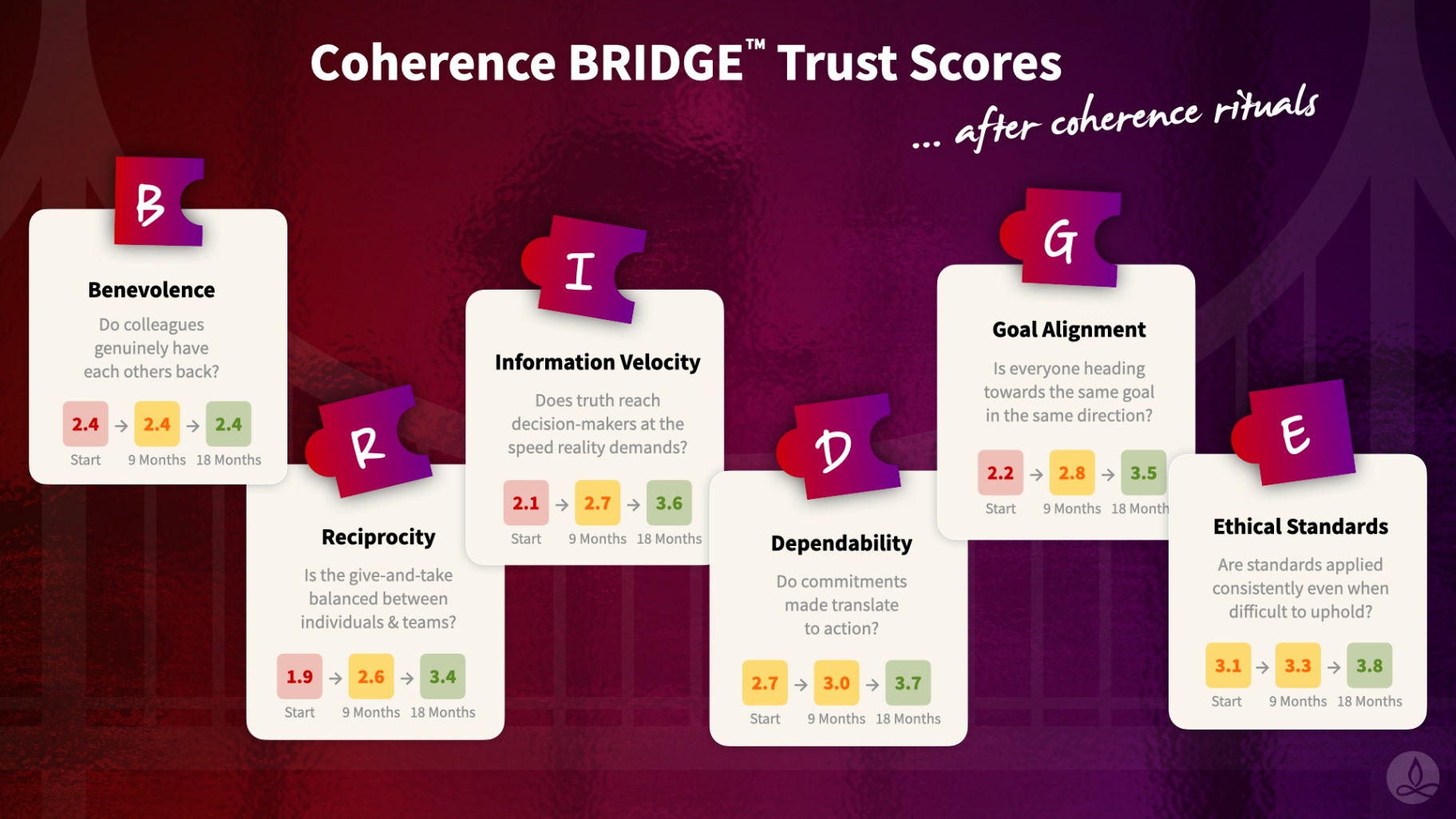
It was not strange. It was the first evidence that his identity could survive without constant performance. The reciprocity scores in the subsequent pulse survey moved from 1.9 to 2.4 within eight weeks—the single largest short-term circuit movement in the engagement, suggesting that the authorship deprivation had been the primary driver of reciprocity breakdown, and that restoring it contributed to recovery at a corresponding pace.
Month 4–5: The Information Velocity Protocol — Creating Safety for Bad News
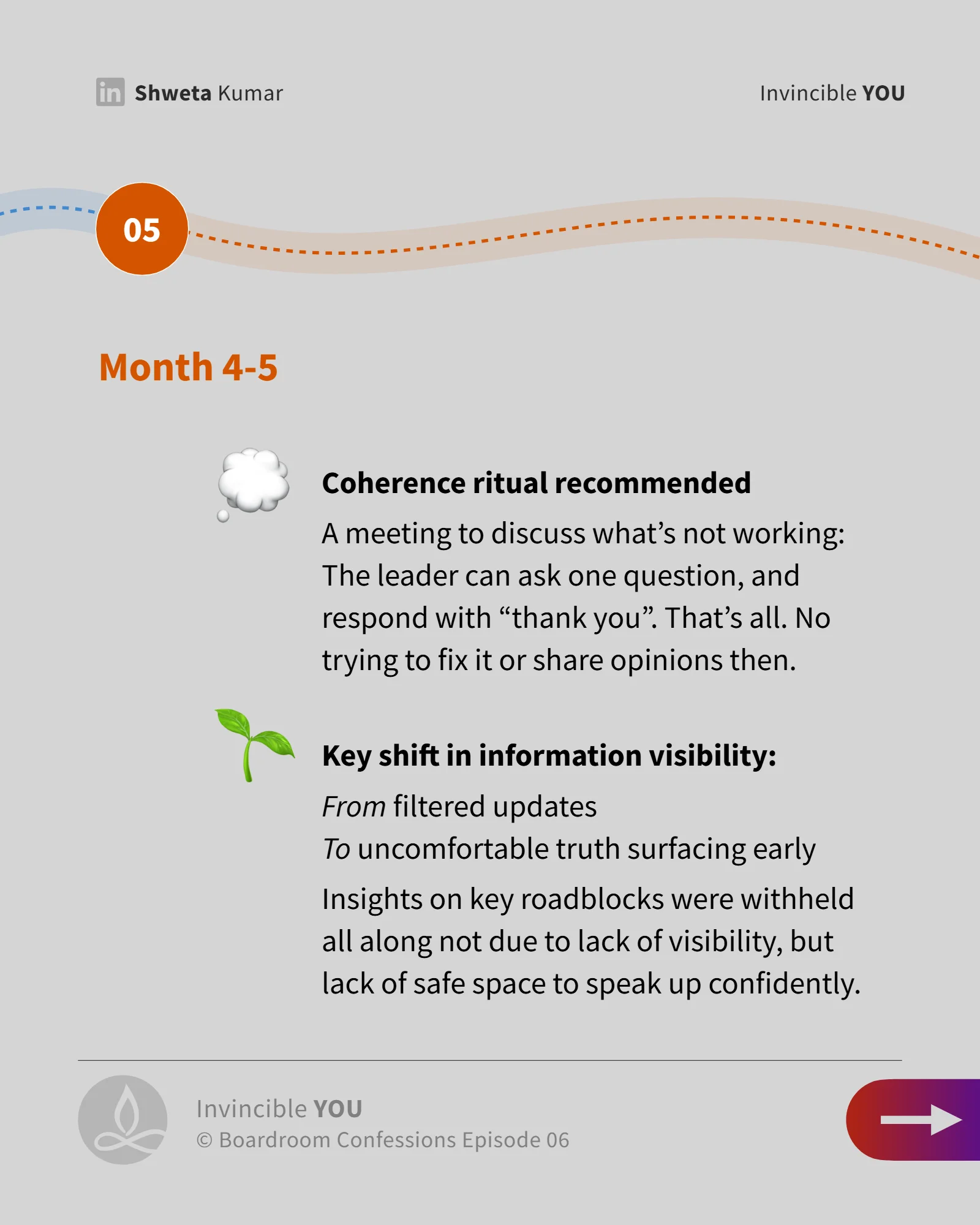
Subroto’s information filtering problem required a cultural intervention that only he could initiate. We designed the Red Flag Ritual: a standing agenda item at the start of every Monday leadership meeting in which each team member was required to share one thing that was not working, without solutions attached.
The rule: Subroto could ask one clarifying question. He could not offer a solution, a reframe, or a framework. He would simply say: “Thank you for surfacing this.”
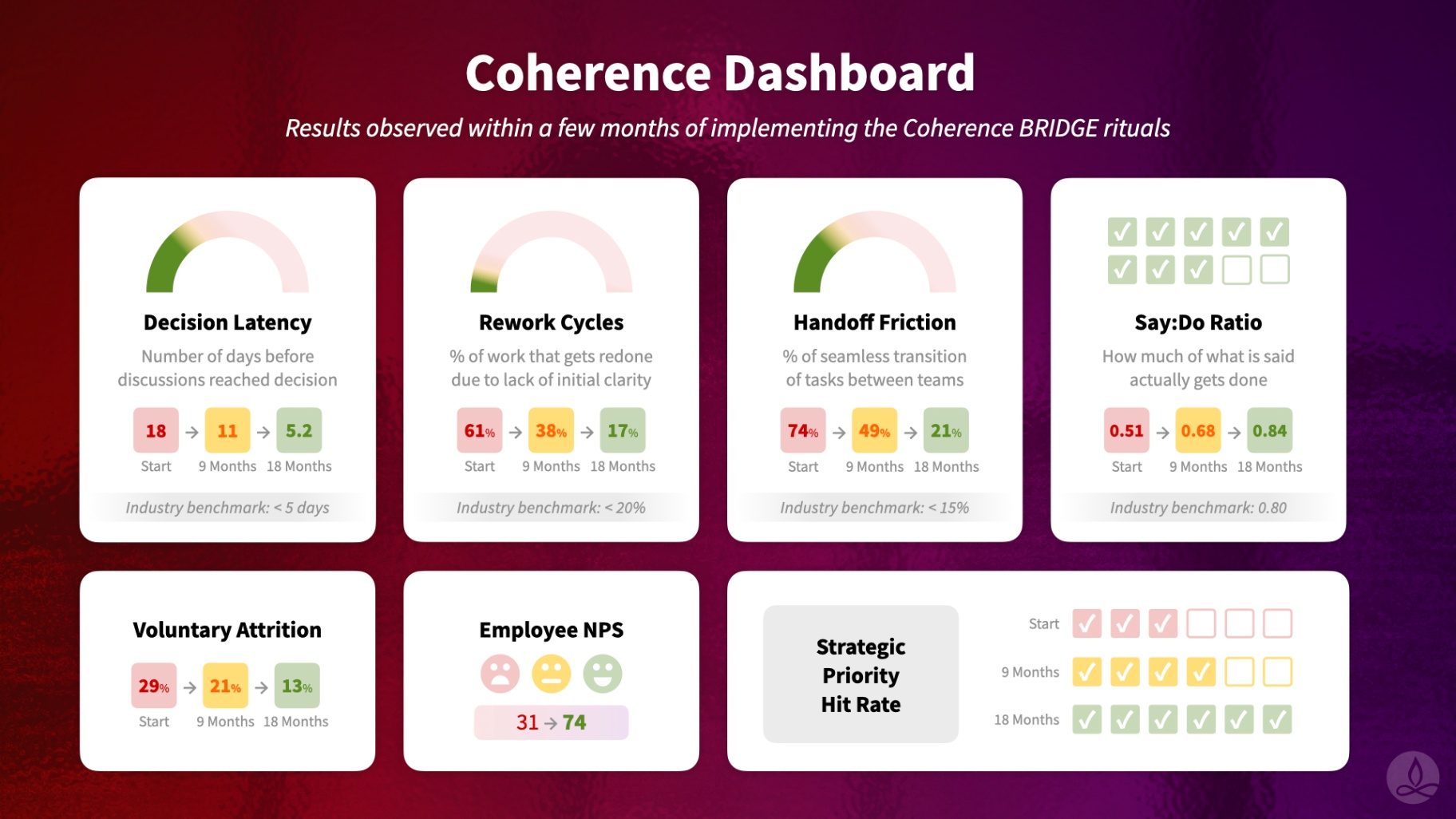
The first three weeks were excruciating for him. The fourth week, his Head of Operations shared a critical supply chain dependency failure that had been quietly managed at the team level for six weeks. Under the old system, it would never have reached him until it became a crisis. The Red Flag Ritual contributed to, alongside the broader trust circuit repair work, a shift from 18 to 11 days in decision latency by the mid-point measurement—a 39% reduction that tracked directly with the improvement in information velocity scores.
Month 5–6: Goal Alignment — From Excellence to Clarity
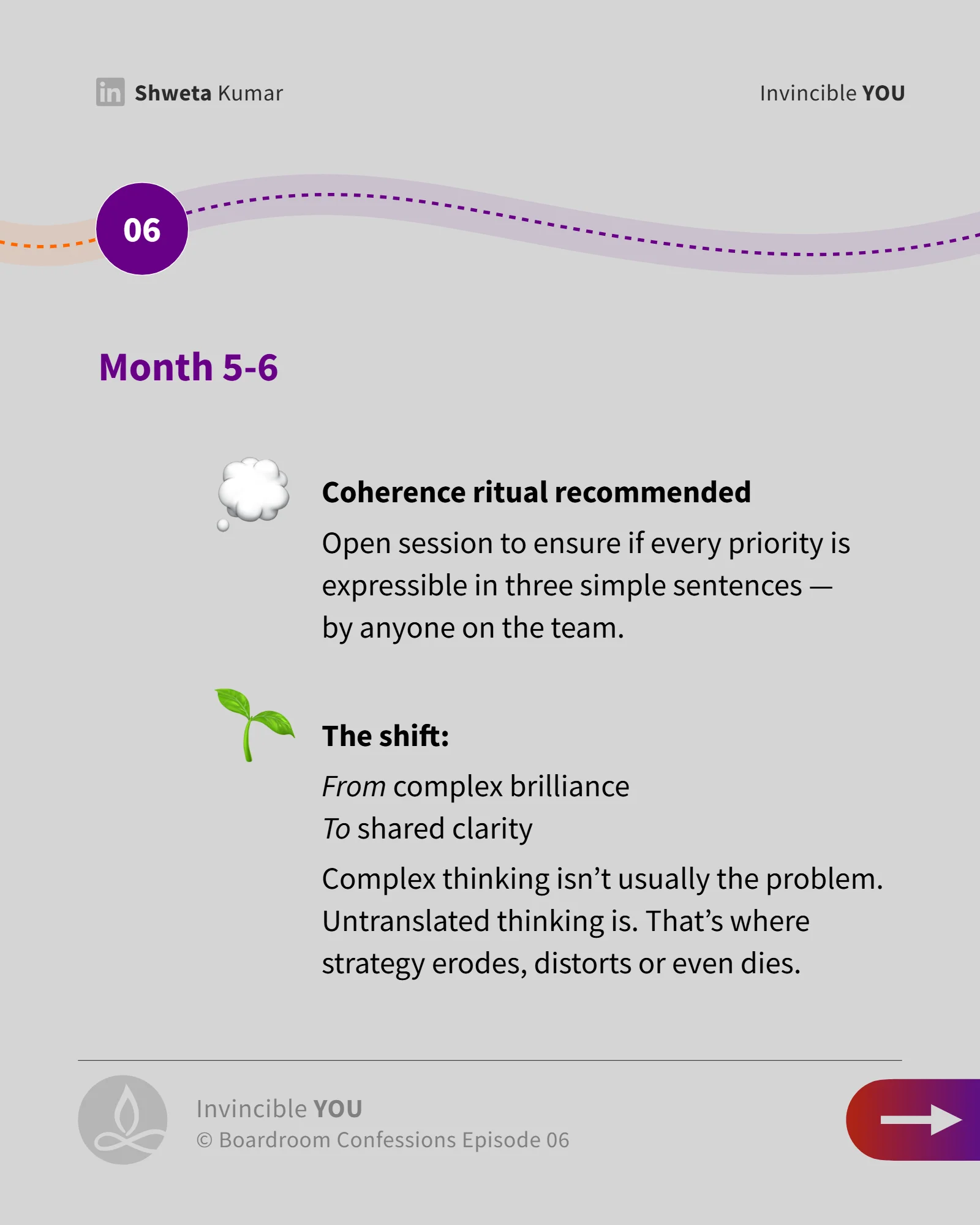
The goal alignment failure required Subroto to do something he found genuinely difficult: say less. His strategy communications were models of sophistication. They were not models of clarity.
We introduced the Three-Sentence Strategy Test: every strategic priority had to be expressible in three sentences by any member of his team, without consulting notes. If it couldn’t, it wasn’t clear enough, regardless of how elegant the underlying framework was.
For a man who thought in systems and expressed himself in comprehensive frameworks, this was almost physically uncomfortable. But the discipline forced a translation he had never previously valued: the translation of excellent thinking into accessible meaning. Within eight weeks, the number of distinct answers to “what are the COO function’s three priorities?” dropped from eleven to three. Not one—healthy teams have productive disagreement about priorities. Three, where the disagreements were known and negotiated rather than invisible and compounding.
Phase 3 Months 7–19 Stabilisation and System Embedding
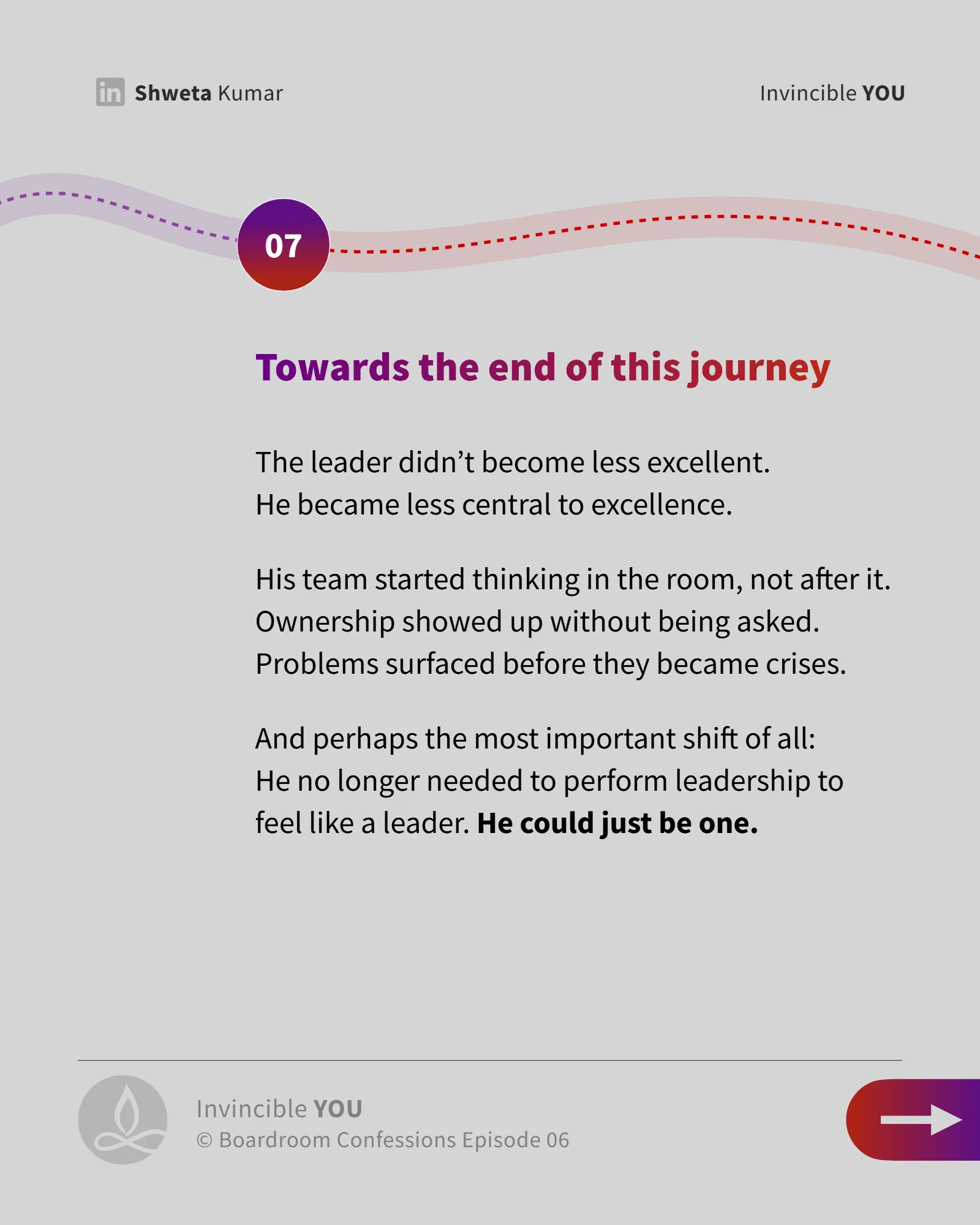
Phase 3 was less about new interventions and more about the gradual absorption of changed behaviour into organisational muscle memory. The trust circuits and execution indicators moved more slowly in this phase, but more durably. By month twelve, the Mid-Point measurements confirmed that the improvements were holding under normal operating pressure. The endpoint measurements at month nineteen confirmed that they had embedded.
The clearest signal that Phase 3 had succeeded was not in the metrics. It was in the absence of regression during two significant system stresses: a board-mandated restructuring of one business unit in month fourteen, and a leadership team departure in month sixteen that had, in the pre-intervention period, been the kind of event that would have triggered information suppression and accountability fragmentation. Neither event produced measurable circuit deterioration.
Year One and Beyond: The Transformation in Numbers and in People
By August 2025, nineteen months after our first conversation, the data told a story of genuine organisational repair.
Exhibit 3 — Full Transformation Summary
Why These Metrics Improved Together
The pattern of improvement across Exhibits 1, 2, and 3 is consistent with what the Coherence Bridge™ framework predicts when internal coherence increases: trust circuits and execution indicators shift together rather than independently. In practice, these shifts reinforced one another rather than unfolding in a perfectly neat sequence—there were feedback loops at every stage. What is visible, however, is a general order: Reciprocity and Benevolence moved earliest, because they are most directly sensitive to whether the leader’s behaviour feels authentic. As psychological safety grew, information velocity followed. As information quality improved, decision latency and rework dropped. The same protocols—the Red Flag Ritual, the Authorship Protocol, the Three-Sentence Strategy Test—worked simultaneously on trust circuits and execution drag, because they were the external expression of an internal coherence shift. Protocols run through a coherent engine produce compounding improvement. Run through a fragmented identity, the same protocols produce compliance without change.
But the numbers, as always, were the shadow of the human reality.
His Head of Strategy, who had been quietly headhunted by a competitor and had been seriously considering leaving, chose to stay. Her reason, shared with me privately: “I finally feel like I work for a leader, not a performance standard.”
His Head of Operations, who had managed the supply chain failure in silence for six weeks, became the most vocal advocate for the Red Flag Ritual. “For the first time in two years,” he told me, “I feel like I’m building something with Subroto instead of building something for him.”
And his most junior direct report—a 31-year-old who had joined from consulting and had privately been terrified of Subroto’s intellectual velocity—presented a flawed-but-innovative operations proposal at a leadership review. It had three significant gaps. Subroto said nothing about the gaps. He said: “This is genuinely new thinking. I’d like the team to help develop it further.”
The proposal, refined collaboratively over six weeks, became one of the three strategic initiatives that drove the group’s operational efficiency gain for the year.
Subroto called me after that review. “Shweta, I used to think the best idea in the room had to come from me. Now I understand that the best outcome comes from the room. Those are very different things. And only one of them scales.”
The COO Who Learned to Become Invisible
The most striking moment of the entire engagement happened in October 2025, two months after the endpoint measurement. Subroto had been invited to present the group’s operational transformation to the parent company’s global leadership conference in Singapore.
He sent me the deck the night before his flight. It was extraordinary—eighty slides of meticulous analysis, trend data, framework integration, and forward projection. Classic Subroto. Brilliant. Comprehensive. And entirely about the work rather than the people who had done it.
I sent him one message: “Who should actually be standing next to you on that stage?”
He arrived in Singapore with four members of his team. He spoke for eleven minutes of a forty-five-minute slot. His team delivered the rest.
The global CEO—a man not known for visible enthusiasm—pulled Subroto aside afterward.
“In fifteen years of these conferences,” he said, “that is the first time a functional COO has walked in with a team that was clearly better because of them, not despite them. Whatever you’re doing, keep doing it.”
Subroto texted me from Changi Airport, waiting for his flight home.
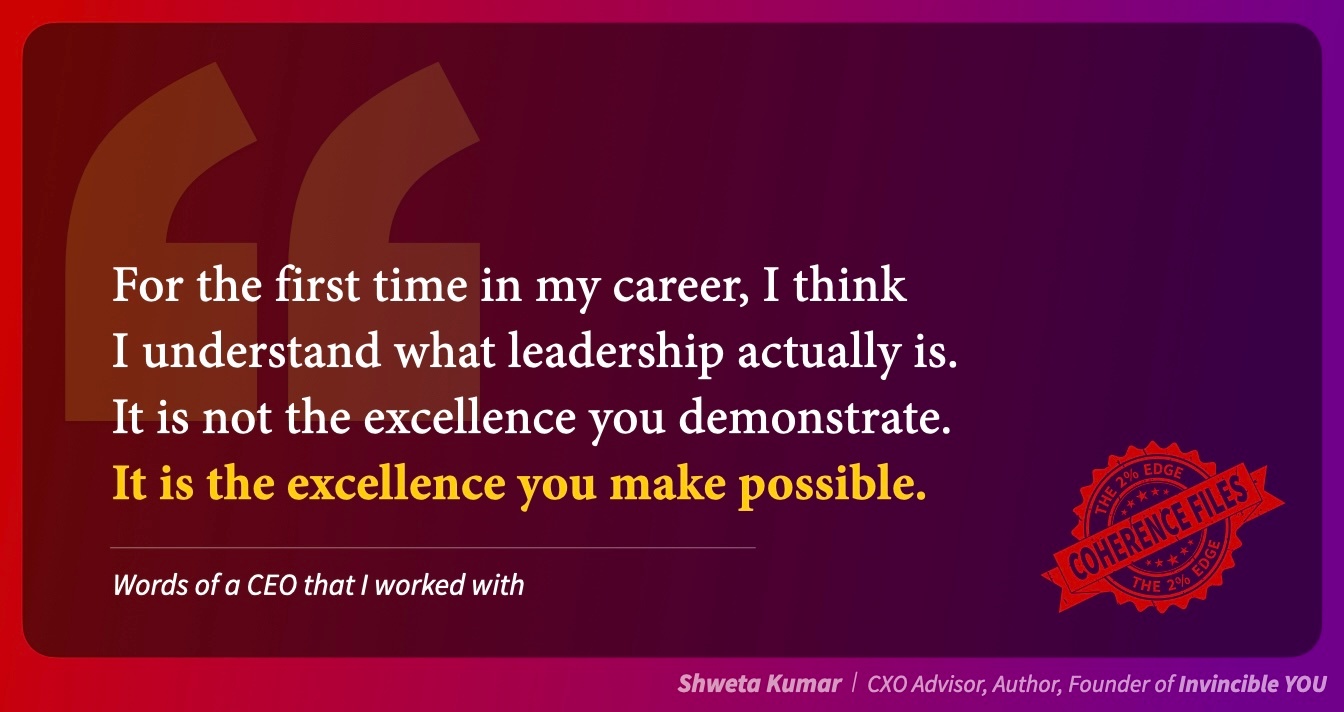
“For the first time in my career, I think I understand what leadership actually is. It is not the excellence you demonstrate. It is the excellence you make possible.”
What Subroto Taught Me
Every leader I work with teaches me something about the architecture of human ambition and its capacity to become its own most sophisticated obstacle. Subroto taught me several things I did not previously understand with such clarity.
Impostor Syndrome at the Top Is Different
The popular conception of impostor syndrome is of someone who doubts they belong. At the senior leadership level, the manifestation is often inverted: someone who cannot stop proving they belong. The compulsive demonstration of excellence is not confidence—it is the immune response of a system that believes excellence is the only protection against exposure. The organisational cost shows up not in the leader’s own distress but in what the team quietly stops doing: proposing, risking, owning. It remains invisible on every conventional metric until the trust circuits reveal it.
The Transition from Function to Enterprise Is a Trust Crisis
The CHRO-to-COO move, and analogous transitions from deep functional expertise to enterprise leadership, are fundamentally identity transitions. They require leaders to relocate the source of their worth from personal output to collective outcomes. Organisations rarely provide the support structures for this transition—the governance and performance machinery that accelerated the leader to their new role is usually optimised for functional mastery, not for identity development. The result is leaders who manage the anxiety of the transition by over-controlling the environment they now inhabit, generating the precise executive drift their new role requires them to prevent.
Trust Circuits Require Internal Coherence to Function
The Coherence Bridge™ framework teaches that trust circuits cannot be rebuilt through protocols alone. They require the leader to have sufficient internal coherence—alignment of identity, intent, and impact—to sustain the practices even when anxiety pulls them back toward old patterns.
Subroto’s trust circuit repair did not begin with new meeting structures or accountability systems. It began with the question: who are you when you are not performing? Until he had an answer that did not require an audience, no organisational intervention would hold. When the internal architecture changed, the external metrics followed—not as a result of the individual protocols, but because a coherent identity was running them.
System Context Shapes the Drift, Even When It Cannot Excuse It
It would be easy to read this case as entirely about one leader’s psychology. It was not. The board’s growth mandate, the governance culture that rewarded visible executive performance, the steep expectations attached to a CHRO-elevated-to-COO role, the multi-layered reporting structures of a large conglomerate—all of these contributed to the context in which Subroto’s patterns were not just tolerated but initially reinforced. Systems shape leaders as much as leaders shape systems. The most durable interventions are those that address both the internal architecture of the individual and the contextual pressures that made their dysfunction adaptive in the first place.
The Last Image
Last month, I was referred by Subroto to a younger COO at a mid-size manufacturing company. When I asked Subroto what he told this leader about our work together, he said:
“I told him that Shweta would make him uncomfortable. That she would show him things he could not unsee. And that the most important thing she would ask him to give up was not a behaviour or a habit. It was the belief that his value depends on being the most excellent person in the room.”
I asked if he was ready to let go of that belief himself, fully.
He laughed. A real laugh, easy and unguarded. “Not fully. But enough. Enough that my team can breathe. Enough that they can be excellent without my shadow falling across their work. Enough that when they succeed, it’s actually theirs.”
He paused, and I heard something I had not heard in our first conversation: the quiet confidence of a man who no longer needs to arrange the chairs before others arrive.
“That’s enough,” he said. “That’s more than enough.”
Note: Names, industry details, and identifying information have been altered to preserve confidentiality. Subroto is a composite; the diagnostic patterns and metric ranges combine observations from multiple senior leadership engagements using the BRIDGE™ framework and DriftX™ diagnostic system.