

How a Leader’s Need to Prove Himself Became the Organisation’s Most Expensive Liability
He arrived twelve minutes early to every meeting. Not because the agenda demanded it, but because arriving first meant he could arrange the chairs, check the projector, and control the room before anyone else walked in. Control was not a strategy for Subroto Bose. It was oxygen.
I first met him in the lobby of a five-star hotel in Gurugram, where he was waiting for me with a printed copy of his “agenda for our conversation” — eight items, time-boxed, with three pages of supporting data. We were meeting for coffee.
It was early 2024. Subroto had just been elevated from CHRO of one of India’s largest conglomerates to its Group COO — a transformation that, on paper, was the crowning achievement of a twenty-three-year career. In reality, it was the beginning of a slow organisational crisis that his brilliance was making worse.
The organisation was not small. The COO function spanned supply chain, technology operations, and enterprise transformation across seven business units and roughly four thousand employees. The board had elevated Subroto on the strength of his CHRO track record: he had redesigned the group’s performance architecture, led a talent transformation that reduced attrition by a third, and built a reputation as the most analytically rigorous people leader the group had known. Growth expectations were steep. The CEO had given him a mandate to double operational efficiency within three years.
“Shweta,” he said, after the pleasantries had been dispensed with in precisely four minutes, “I need you to help me understand why my team is underperforming. I’ve given them everything. Frameworks. Dashboards. Weekly reviews. My own templates. My own methodology from my CHRO years. And yet…” He paused, genuinely perplexed. “And yet we’re missing the mark on three of our six strategic priorities.”
He did not say: “I might be part of the problem.” That sentence did not yet exist in Subroto’s vocabulary.
The Shape of a High-Achiever’s Wound
Subroto’s story was not unusual among the leaders I work with who arrive at the top with something to prove.
The son of a lower-middle-class family in Bhubaneswar, he had watched his father, a government school teacher, navigate a lifetime of deference to people less capable than him. The lesson young Subroto drew was visceral and permanent: competence must be visible, or it doesn’t exist. Excellence must be demonstrated, constantly, or it will be taken from you.
He built his career on this foundation. First-rank in every examination. Scholarship to XLRI. Hired by a top-tier conglomerate straight from campus. Promoted faster than any CHRO in the group’s history. He collected achievements the way other people collect insurance — against the fear of being found inadequate.
What no one told him was that the armour he built to protect against inadequacy had, by the time he became COO, become the very thing suffocating the people around him.
The Drift Beneath the Dashboard
The numbers shown in the exhibits below combine diagnostic patterns from multiple engagements into a single, coherent narrative arc. While Subroto is a composite character, the metric ranges and circuit profiles reflect real engagements.
The BRIDGE™ and DriftX™ Frameworks
The Coherence Bridge™ framework decomposes organisational trust into six measurable circuits—Benevolence, Reciprocity, Information Velocity, Dependability, Goal Alignment, and Ethical Standards—that, when weakened, reliably show up as execution drag: slowed decisions, increased rework, handoff friction, and talent flight. The DriftX™ diagnostic measures how these circuit failures translate into quantifiable execution costs. Together, they provide the diagnostic infrastructure for identifying and reversing Executive Drift™: the widening gap between what a leader believes they are delivering and what the organisation actually experiences in day-to-day execution.
Over three weeks, I conducted what became one of the more painful organisational diagnostics I’ve run. Painful not because the data was unclear, but because Subroto — brilliant, meticulous, genuinely well-intentioned Subroto — had erected, unknowingly, an architecture of systematic suppression while believing he was building a culture of excellence.
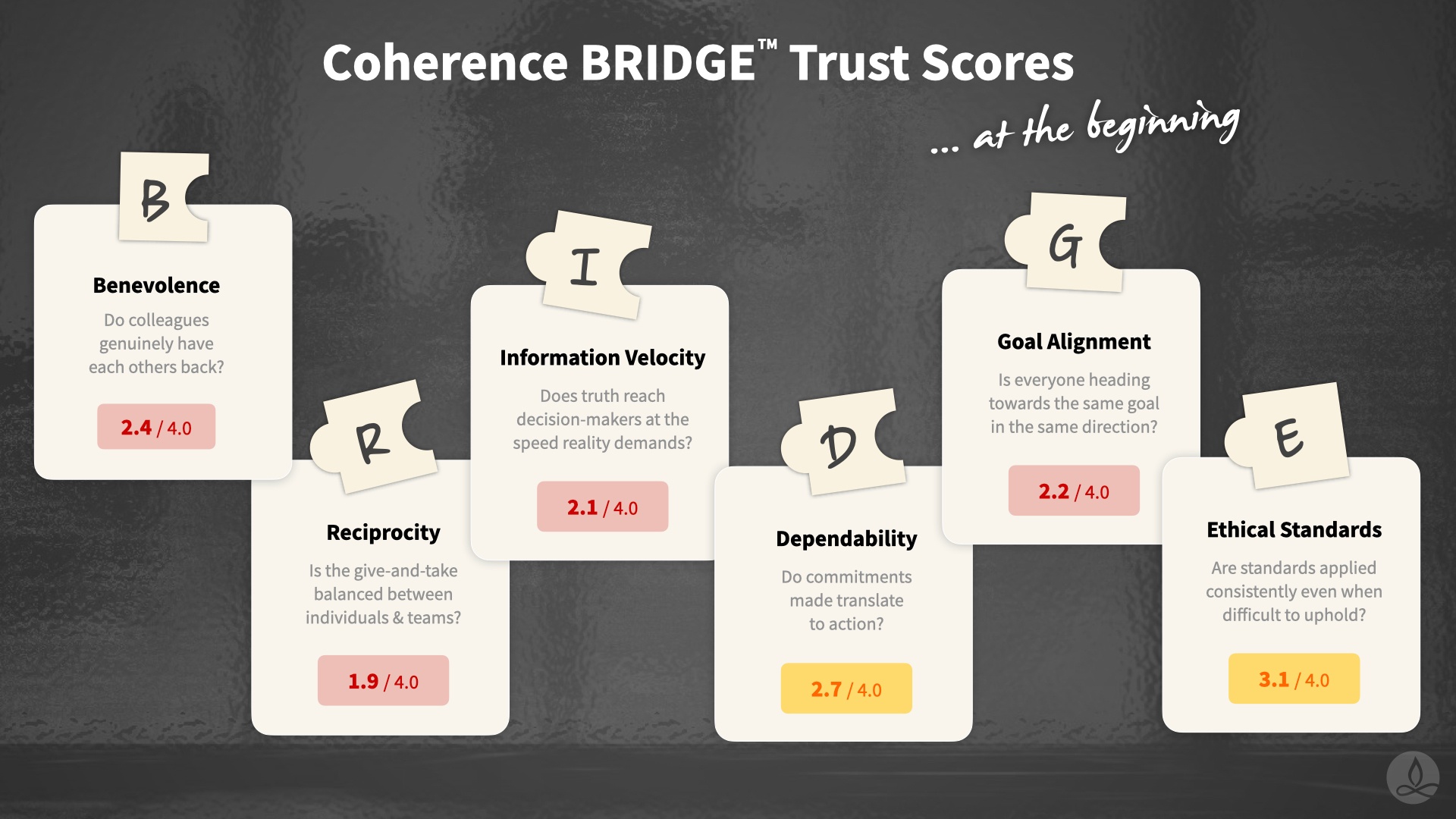
The BRIDGE diagnostic across his six trust circuits told the story with clinical precision.
Exhibit 1 — BRIDGE Trust Circuit Scores
Scale: 1.0–4.0
🔴 Red < 2.5 | 🟡 Amber 2.5–3.0 | 🟢 Green > 3.0. Ethical Standards at 3.1 was the comparatively strongest circuit at baseline; in this governance-intensive conglomerate context, consistent value behaviour was more embedded than relational trust, though all circuits remained below the 3.5 threshold associated with sustained execution reliability.
But the trust circuit scores only told me what had broken. The operational drift indicators told me the cost.
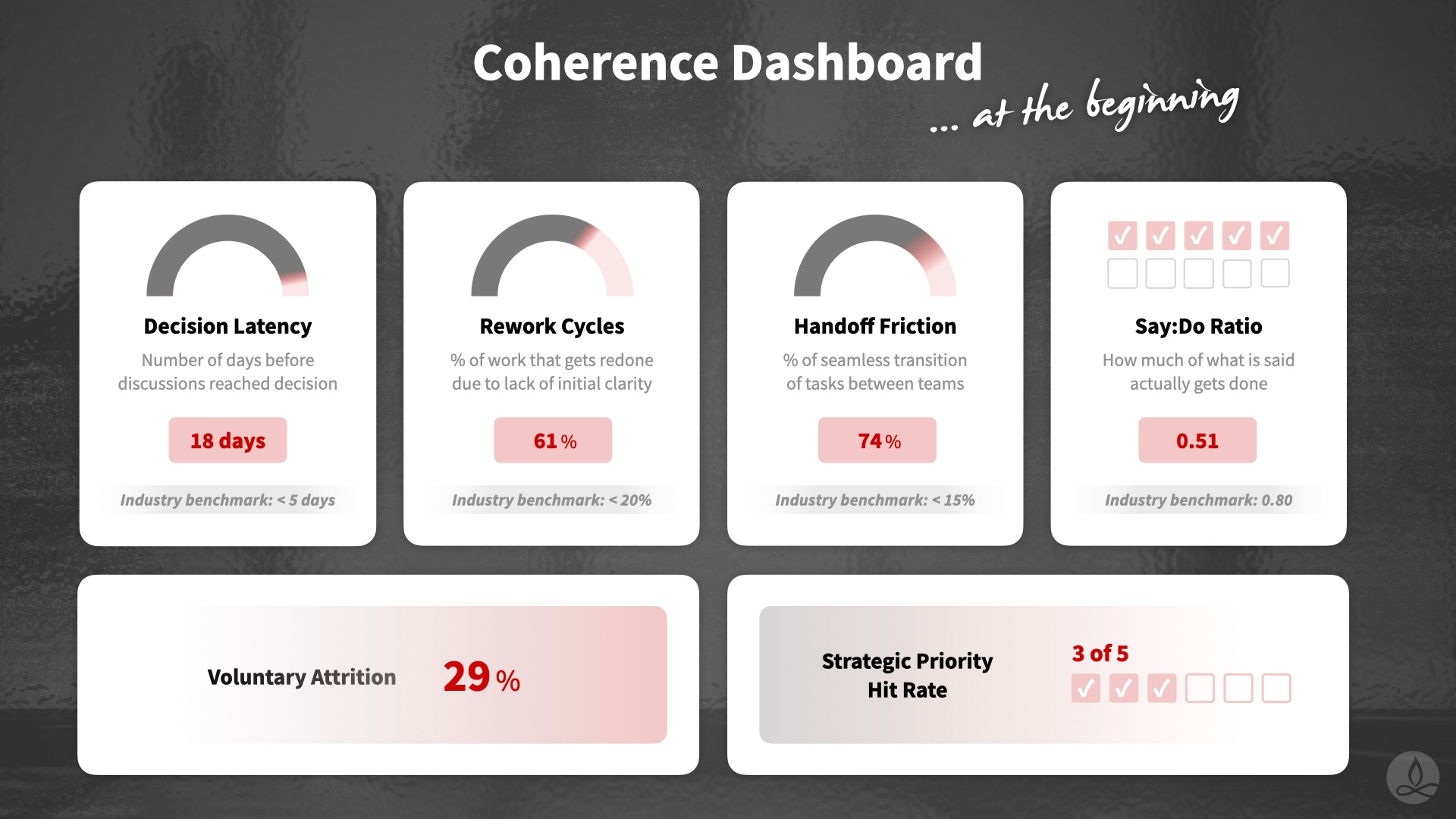
Exhibit 2 — DriftX™ Execution Indicators
What Executive Drift Looks Like in Numbers
This is what Executive Drift looks like in numbers. Decision latency of 18 days, rework touching 61% of projects, and three of six strategic priorities missed are not random operational failures. They are the downstream symptoms of trust circuit breakdown: when reciprocity collapses, discretionary effort withdraws and idea quality drops, producing rework. When information velocity stalls, decision-makers act on filtered signals, compounding latency. When goal alignment fractures, cross-functional handoffs fail because people are optimising for different things. In Subroto’s case, the drift was generated primarily by the interaction between the COO’s brilliance and a context that actively rewarded visible executive control. His identity as ‘the most excellent person in the room’ pulled him away from the COO’s actual function—orchestrating execution through others—and a governance culture that equated senior visibility with senior value made that pull stronger. The more he compensated for team gaps by inserting himself into the work, the more those gaps persisted, because the team never had to close them. As the trust circuits and execution indicators shifted—in both directions over the course of the engagement—the pattern that emerged was consistent with a coherence failure rather than a capability failure.
The qualitative data from anonymous pulse interviews confirmed the cause with uncomfortable precision.
“We’re afraid to bring him half-formed ideas. He improves them so thoroughly that they stop being ours. And then we stop having ideas.”
“Subroto doesn’t delegate. He ‘temporarily assigns’ things to us while he monitors every step. It’s exhausting. And it communicates that he doesn’t actually trust us.”
“The man is brilliant. Genuinely brilliant. But sitting in his review meetings feels like being audited, not supported. I leave every session smaller than I arrived.”
The Six Circuit Breakdowns: What the Impostor Was Really Doing
The BRIDGE framework draws on the foundational Mayer-Davis-Schoorman trust model—which identifies ability, benevolence, and integrity as the core antecedents of trust—and extends it into six circuits specifically calibrated for senior leadership team dynamics. The distinction between affective trust (do I believe you care?) and cognitive trust (do I believe you are capable and consistent?) is present in all six, but in different proportions. What Subroto’s diagnostic revealed was a systematic failure of affective trust: his team’s cognitive trust in his capability was high throughout. Their affective trust—the felt sense of safety, reciprocity, and genuine support—was what had collapsed.
Benevolence Circuit Drift — Score: 2.4 / 4.0
The benevolence circuit measures whether people feel their leader genuinely has their long-term interests at heart. In trust research terms, this is the affective core: the belief that another party will not act against your interests even when they could. Subroto believed, sincerely, that he did. He stayed late to review his team’s work. He provided detailed feedback. He sent resources and frameworks.
But benevolence, as his team experienced it, was entirely conditional. Support arrived when performance met his standard. When it didn’t, the support transformed into interrogation. The underlying message, never stated but universally received, was: I will care for you as long as you do not embarrass me.
The execution consequence of this was direct: when care is conditional, experimentation dies. People stop taking the interpersonal risks that learning and innovation require. The team became technically proficient and psychologically cautious—a combination that produces reliable mediocrity rather than the step-change performance the COO mandate required.
The psychodynamic substrate here was classic: Subroto’s impostor anxiety meant that his team’s failures felt like his failures, which felt like evidence of his inadequacy. Care had been colonised by self-protection.
Reciprocity Circuit Drift — Score: 1.9 / 4.0 (Lowest in diagnostic)
This was the wound that was bleeding most. Subroto’s team worked harder than almost any senior leadership group I’ve encountered. The reciprocity failure was not about effort. It was about authorship.
Subroto consistently over-contributed—rewriting presentations, revising strategies, correcting analyses—while simultaneously ensuring that the final product bore the unmistakable architecture of his thinking. His team was not building with him. They were building for him. And they knew it.
The invisible ledger read: We give our best work. He gives it back transformed into something that is no longer quite ours, and then presents the combined result as a team achievement. When one party consistently over-contributes in ways that erase the other’s contribution, discretionary intellectual effort is the first casualty. The quiet withdrawal was inevitable—and it was not visible on any of Subroto’s dashboards until we measured it.
Information Velocity Circuit Drift — Score: 2.1 / 4.0
In Subroto’s organisation, information moved fast toward him and slowly away from him. He had built dashboards, reporting rhythms, and escalation protocols that ensured he was the best-informed person in any room.
What he had not noticed was the second-order effect: his team had learned to pre-filter information before it reached him. Bad news required three iterations of framing. Weak signals were suppressed until they became strong enough to be presented with solutions attached. This is a classic trust failure in information processing terms: when people manage impressions rather than surface reality, they are making a rational calculation that the cost of delivering unpolished truth exceeds the benefit of early warning. The system had become not an information network but a performance management system disguised as one.
The execution cost was direct. Decision latency of 18 days was partly structural. It was substantially the time it took for his team to prepare information in a form they believed he would accept. Every week of delay was a week of compounding execution drag.
Dependability Circuit Drift — Score: 2.7 / 4.0
Subroto’s say-do ratio of 0.51 was, at first glance, puzzling. He was not a leader who made promises lightly. He was meticulous about commitment.
The failure was subtler. Subroto over-committed on behalf of his team without consulting them. In his desire to demonstrate organisational capability to the board and the CEO—in a context of steep growth expectations and genuine governance pressure from above—he would commit to timelines that his team then had to either heroically deliver or quietly miss. The intentions were impeccable. The impact was a team that had learned to hold commitments loosely because the man above them kept writing cheques their capacity couldn’t cash. Planning reliability degrades when teams cannot trust the commitments made in their name; the rational response is to build invisible slack into every estimate, which makes the problem self-perpetuating.
Goal Alignment Circuit Drift — Score: 2.2 / 4.0
Here was the deepest structural failure. When we asked Subroto’s direct reports to articulate the three priorities that the COO function existed to deliver, we received eleven distinct answers from eight people.
The cause was architectural. Subroto communicated strategy through the medium of excellence—detailed frameworks, sophisticated analyses, comprehensive roadmaps. What he did not do was translate strategy into clarity. His team understood the shape of the work. They did not share a common understanding of the why, which meant that under pressure—when the frameworks couldn’t cover the situation—each person navigated by their own reading of his priorities. The cross-functional coherence required for complex execution never materialised, because each function was optimising for a different reading of enterprise intent.
They were not climbing different mountains. They were climbing the same mountain through routes that never converged.
Ethical Standards Circuit — Score: 3.1 / 4.0 (Comparatively strongest)
This was Subroto’s most resilient circuit, and it mattered in ways that shaped everything else. His team did not doubt his integrity. They did not believe he was self-serving or manipulative. In this governance-intensive conglomerate context—where board accountability and group reporting standards were consistently enforced—consistent value behaviour was more structurally embedded than in less regulated environments, which contributed to the comparatively stronger baseline score.
The ethical baseline functioned as a trust floor: even as other circuits eroded, cynicism about his fundamental character did not take hold. Research on trust deterioration suggests that when integrity holds, recovery is significantly faster than when it is compromised. In Subroto’s case, this floor proved essential to the speed of repair.
But integrity without vulnerability creates a particular kind of distance. His team experienced him as principled but unreachable. A standard-bearer who did not admit to carrying any weight of his own.
The Moment of Recognition
Six weeks into the engagement, I presented the findings to Subroto in the same conference room he had arranged perfectly for our first session together. I asked him to leave the chairs as they were.
He read the report with the focused attention he brought to everything. When he looked up, his face had the expression of a man who has been handed an X-ray and recognised the fracture he had been walking on.
“I thought I was building an excellent team. I was building an excellent mirror.”
He was quiet for a long moment.
“In my CHRO years,” he said finally, “I could demonstrate excellence through my own output. Every HR policy I designed, every talent framework I built—those were mine. The quality was visible and it was attributable. Here, excellence has to flow through other people. And I didn’t know how to let it be theirs without feeling…” he searched for the word, “invisible.”
That single word—invisible—unlocked the whole system.
Subroto’s impostor syndrome was not the ordinary variety that whispers “you don’t belong here.” His was more sophisticated and therefore more dangerous: it whispered “if you cannot be seen to be excellent, you will be found out.” The CHRO-to-COO transition had removed his most reliable proof of existence. He had compensated by making himself indispensable to everything, visible in everything, and architecturally central to every output.
The cost was a team that had quietly, professionally, and without any drama whatsoever, stopped growing.
His greatest asset became the ultimate prison for him and his team.
With everything at stake, but now with this discovery, how did Subroto shatter the "trap of excellence" to liberate himself and his team? What was truly fracturing beneath the surface, and how did he finally confront it?
The reckoning begins in our next episode.
This chapter is to be continued. Stay tuned.
Note: Names, industry details, and identifying information have been altered to preserve confidentiality. Subroto is a composite; the diagnostic patterns and metric ranges combine observations from multiple senior leadership engagements using the BRIDGE™ framework and DriftX™ diagnostic system.

.jpg&w=3840&q=75)

