.jpg&w=3840&q=75)
You might have launched leadership transformation programs or done org restructures before.
New idea, strategy.
New operating model.
New leadership hires.
Sharper dashboards.
For a while after launch, it feels powerful with rapid movement and energy.
And then something invisible pulls the system back.
Old dynamics resurface.
Decisions stall.
People comply but don’t commit.
Execution loses velocity.
You start wondering:
Is it talent?
Capability?
Middle management?
Culture?
After coaching 2,500+ leaders across boards, CXOs of conglomerates, founder-led businesses, and succession transitions, we’ve seen the same root pattern repeatedly:
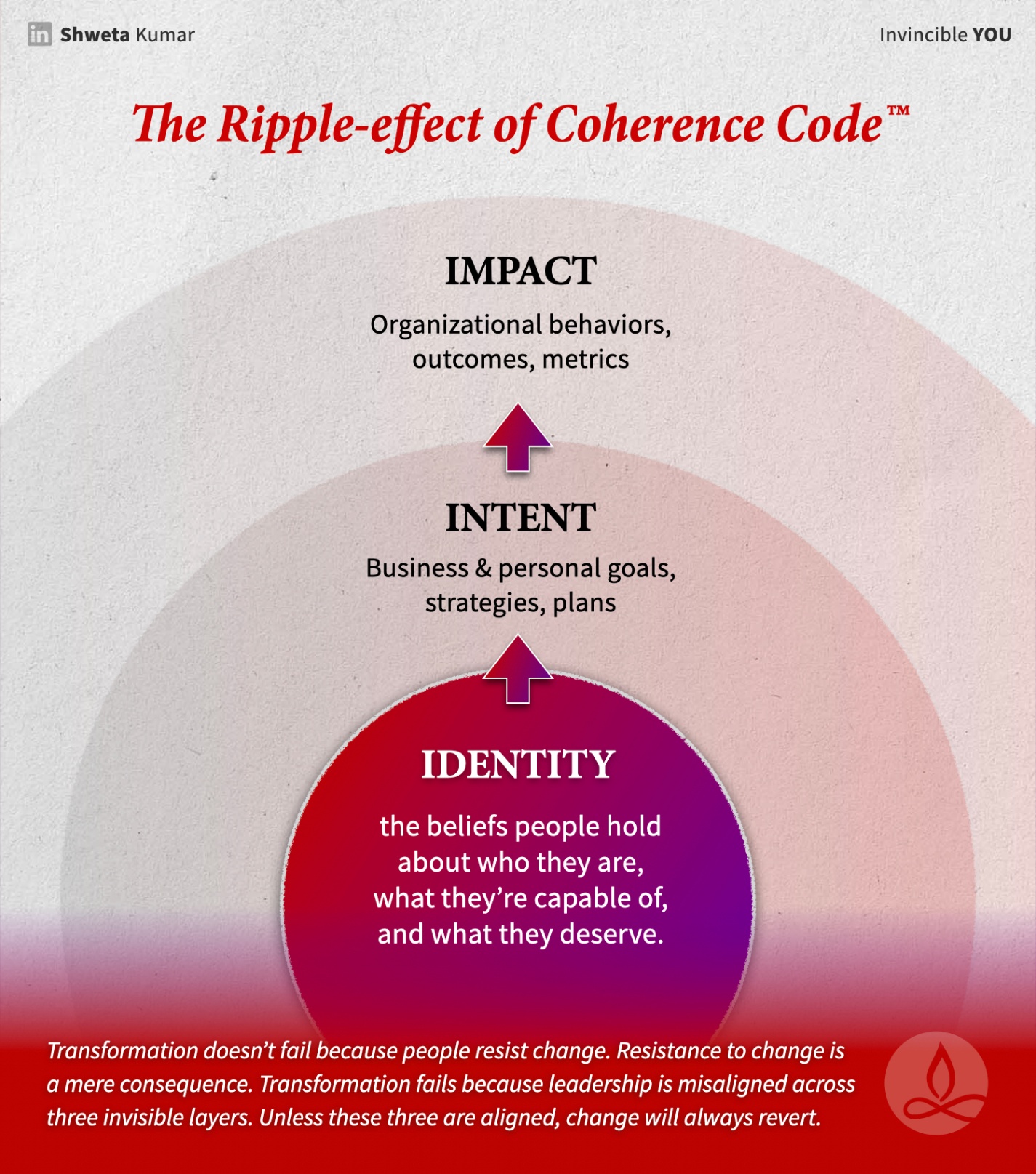
1. Identity we are operating from
(Whether we realize it or not)
Identity is not our designation.
It is how we see ourselves in the role.
It is the story we carry about:
-
What we are permitted to claim
-
How much authority we truly own
-
Whether we are here to preserve, prove, or transform
-
What is “safe” for us to say
Most leaders underestimate this layer, but identity quietly sets the ceiling for everything else.
-
When successor CEOs who inherit the position unconsciously see themselves as temporary custodians, their authority declines and they start working under the shadow of past leadership.
-
Senior ground staff who believed their job was delivery, not direction withheld key execution-level insights that could have avoided multiple reworks.
-
Founders who saw themselves as indispensable problem-solvers long after scale, kept themselves from focussing on what matters most — to become system-builders.
(All the above are real stories we’ve seen & enabled)
No strategy or initiative can rise above the identity of the person because identity drives what we dare to intend.
2. Intent
(What we agree on vs. What we truly act on)
Intent is what leaders articulate as goals, strategies, and priorities.
But stated intent is often aspirational.
Effective intent is what our identity actually permits us to do.
A team may agree on a bold strategic priority. But if the leader’s identity carries fear of conflict, of disappointing stakeholders, or of past failure — the intent enacted is diluted, compromised, or quietly deferred.
We see this over and over:
A CEO launches a major growth initiative.
The presentations are crisp.
The board approves.
And then…
Execution never gets full velocity.
Why?
The internal, unspoken narrative (individual identities) of misbeliefs, fear, approval-seeking tendencies might have made the team members pull the executed intent in a different directions.
3. Impact
(The consequential outcome of Identity + Intent)
Impact is what actually happens on the ground:
-
Decisions that are made or postponed
-
Conflict that is surfaced or avoided
-
Trust that is strengthened or eroded
-
Velocity that accelerates or stalls
Impact is not an isolated result. It is the residual outcome of identity filtering intent into behaviour.
You can try to “fix impact” with a redesigned process, launching new tools, tweaking OKRs — but if the underlying identity and intent remain misaligned, the same pattern returns.
Without internal coherence, impact reforms temporarily.
It never results in sustained transformation.
Identity shapes Intent. Intent shapes Impact.
Once leaders see this, everything changes.
Some real examples from our coaching sessions that illuminate how powerful the connection is between Identity → Intent → Impact:
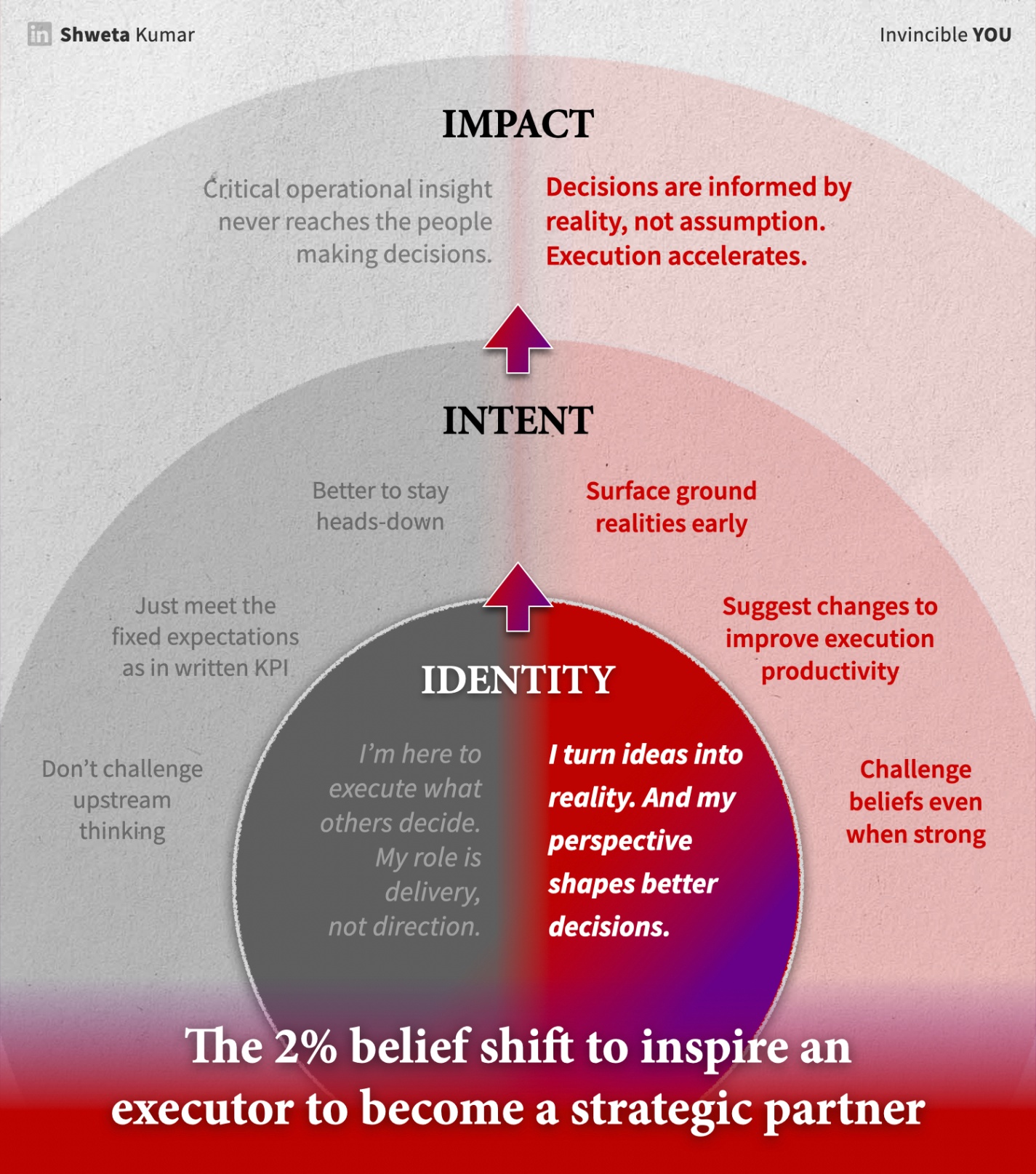
1. From Executor to Strategic Informer
A production head who has been with the organization for 28 years had faced several leaderships that made him see his role as purely execution: deliver what leadership decided, not shape the thinking.
This belief kept him heads-down and dependable, but it also meant critical operational insight never reached the decision table, leading to avoidable blind spots and repeated course corrections.
After a couple of disciplined coherence sessions that inspired him to change this belief, his new Identity became: “I turn ideas into reality, and my perspective shapes better decisions.”
Once identity shifted, his intent inevitably changed, and the impact started showing up in sharpened debates at the decision table, better-informed decisions, and faster execution — all without a single new KPI.
This was the effect of the 3-Is behind the scenes:
2. The New Leader Who Claimed Her Authority
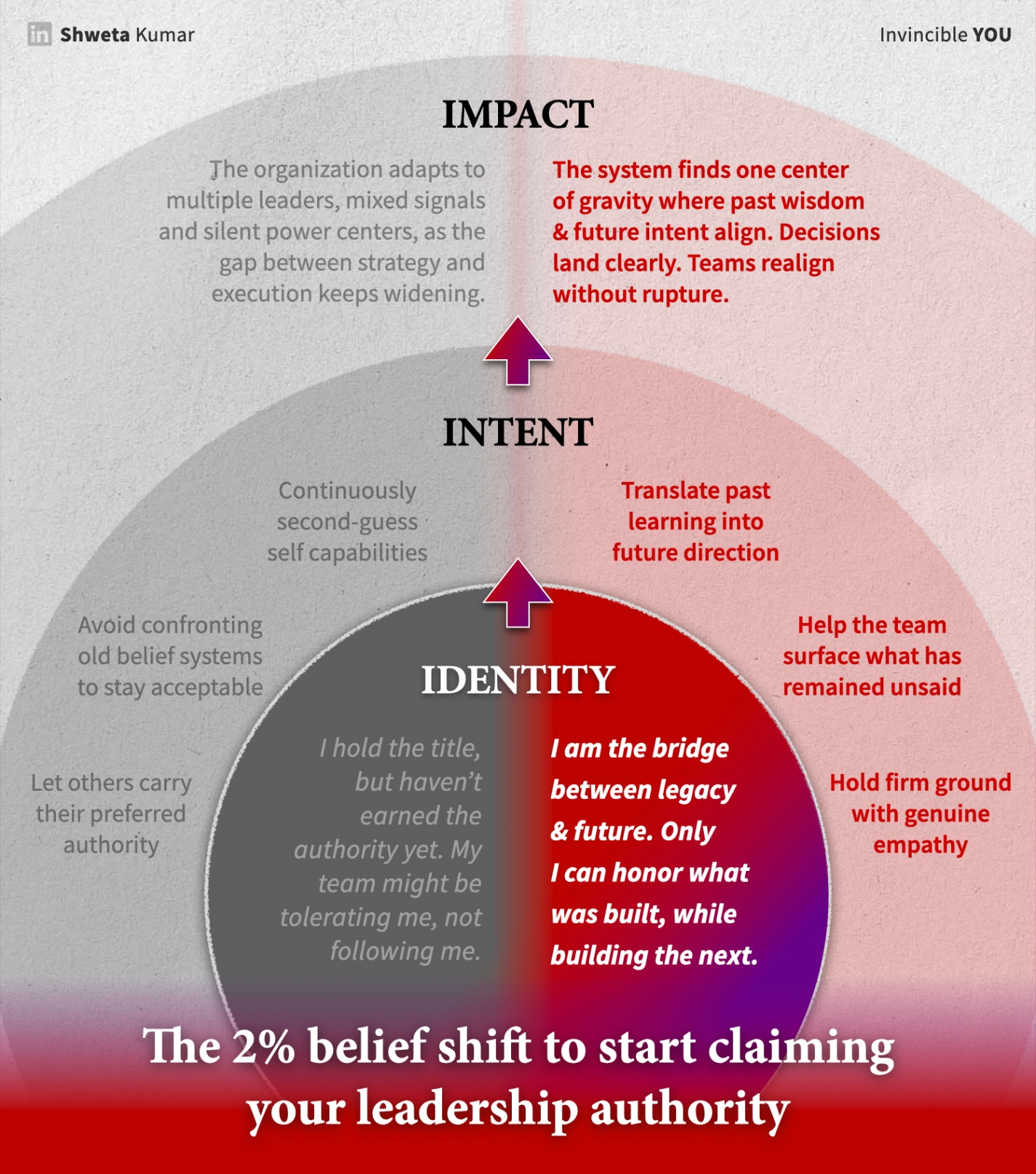
A third-generation leader who had inherited the title carried a quiet doubt: the real authority still belonged to the previous leader. Wanting to preserve harmony with veteran board members, she avoided confrontation, and over time multiple power centers emerged, sending mixed signals and fragmenting strategy.
Then came the shift after a few coaching sessions, and powerful coherence rituals:
She started believing in her new identity: “I am the bridge between legacy and future. The center must hold with me.”
And this is the transformation that rippled throughout the organization, without any reorg or dramatic announcements:
Coherence begins with who we are inside.
It is the foundational pattern behind transformation that lasts.
Why traditional leadership fixes keep failing
Majority of the workshops, frameworks, and even coaching interventions out there treat behaviour as the entry point. But behaviour is a symptom — not the root.
One of the deepest patterns we see is inherited silence.
Leaders carry identities shaped by:
-
Founders they don’t want to contradict
-
Boards they don’t want to disappoint
-
Industries that punish visible vulnerability
-
Upbringings that equated authority with control
Over time, this produces subtle silence:
-
What should be said — isn’t
-
What should be challenged — isn’t
-
What should be owned — isn’t
The organization feels it.
And mirrors it.
You can demand agility
….
but if leaders see themselves as unmoving protectors of heritage, agility won’t come.
You can ask for candor
….
but if people see themselves as guests in someone else’s power structure, candor won’t surface.
You can announce empowerment
….
but if they see themselves as the ultimate safety net for every decision, delegation will remain cosmetic.
Impact cannot outperform identity. That is how execution gaps widen — not through incompetence, but through unspoken misalignment.
So what can you do to ensure transformations stick?
You start with identity.
And you start with your identity.
You ask:
-
Who am I being inside this role?
-
What stories about myself limit my action?
-
Which internal beliefs am I conflating with truth?
Once your own identity becomes visible and understood, you can then calibrate intent that truly reflects your internal operating system — not just a desired state. This starts creating a subtle shift in the way you interact with your team, and vice versa. It will become easier for you to then hold the capacity for your team to work on theirs.
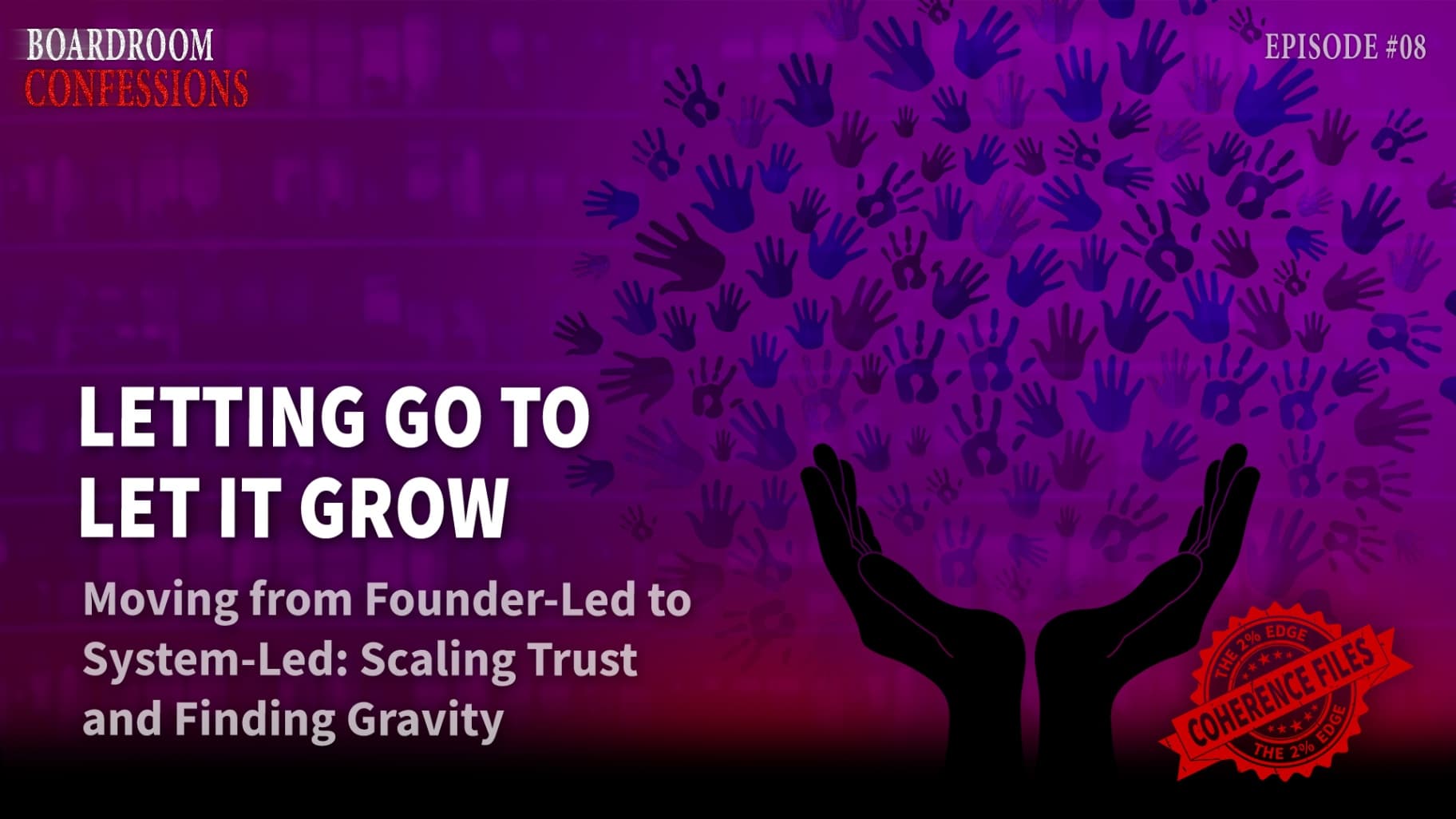
(If you wish to explore how this works, check out this episode of our web series "Boardroom Confessions" where the 3-I shift is enabled for leaders at every level of the organization, by the leader building her inner coherence as the first step.)
The pattern repeating across 2,500+ leaders
Across industries, geographies, and ownership structures, the pattern is consistent:
When identity is reactive, intent is cautious, and impact is fragmented.
When identity is grounded, intent is coherent, and impact accelerates.
Fixing impact without understanding identity is like trying to steer a ship by decorating the sails. The course must be determined from within — otherwise the wind simply carries you back to the same shore.
In summary,
Identity defines the internal limits and possibilities a leader unconsciously carries.
Intent is what you say you want, but its integrity depends on identity.
Impact is what actually happens, and it can never be stronger than the coherence between identity and intent.
Aligned across these three layers is not philosophical. It is operational, and it is the difference between transformation that performs for a quarter, and transformation that reshapes trajectory.